The Vagus Nerve Device That Doesn’t Shock, Buzz, or Freeze You. It Also Does 59 Other Things.
Most vagus devices send electrical pulses into your neck or ear, and that is all they do. The VIBE uses gentle resonance frequencies instead. Wear it on the lanyard over your chest or slip it in a pocket, press one button, and run the Vagus Nerve protocol. Tomorrow, run Sleep. The day after, run whatever your body is asking for. One device, sixty protocols, nothing to endure.
One button · No app, no setup · No subscription, ever

The Vagus Nerve, in Two Minutes.
You have one nerve that runs from your brainstem down through your neck and chest into your gut, and it touches nearly every major organ on the way. Heart, lungs, stomach, intestines. It is the longest nerve in the body, and its name comes from the Latin for “wandering,” because that is what it does.
Its job is to be the brake. Your body has an accelerator — the stress response that speeds your heart, tightens your muscles and shuts down digestion when something feels like a threat. The vagus nerve is the system that takes your foot off the pedal: it slows the heart back down, restarts digestion, lowers the shoulders, and tells the body it is safe to rest and repair.
The trouble is that modern life leans on the accelerator all day. Deadlines, screens, traffic, bad sleep, the news. The brake gets used less and less, and like any part of the body that goes unused, it loses tone. That is what people mean by “low vagal tone” — a body that takes a long time to come back down after stress, or never quite does.
Good vagal tone is the opposite. Stress still happens, but you recover from it quickly. Heart rate settles, breathing deepens, digestion runs smoothly, sleep comes easier. Researchers measure it through heart rate variability — how flexibly your heart adjusts beat to beat — and higher is better. It is one of the few things in wellness that touches calm, sleep, digestion, focus and recovery at the same time, which is why the vagus nerve went from an anatomy footnote to the most talked-about nerve on the internet.
The good news: vagal tone can be trained. Slow breathing does it. Cold water does it. Humming does it. So does gently stimulating the nerve where it lives — and that is where the choices start.
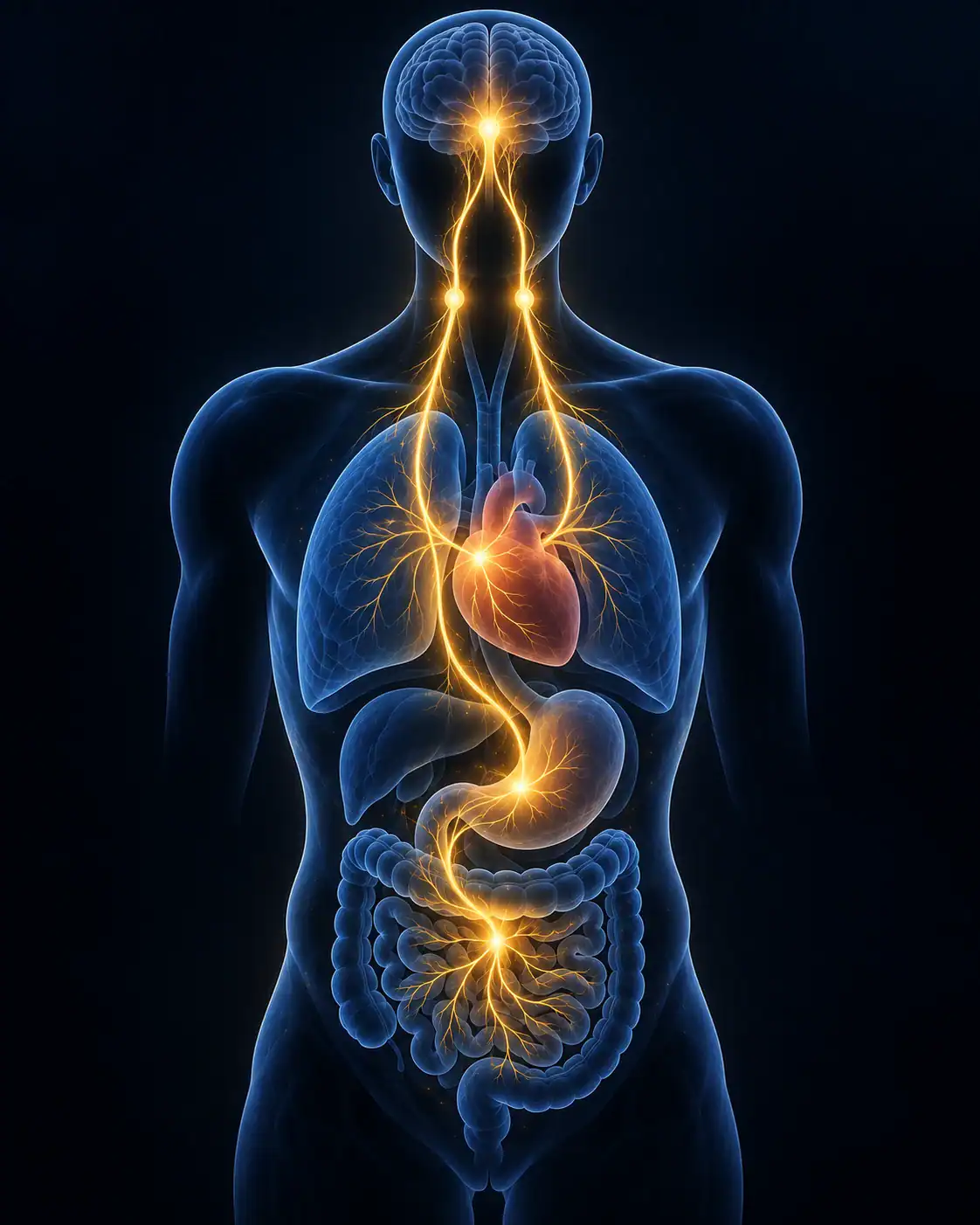
- Brainstemwhere it starts
- Neckvoice, swallowing
- Heart & lungsheart rate, breathing
- Stomachdigestion
- Gutthe gut-brain line
One wandering nerve
Brainstem to gut, touching every major organ on the way
The Internet’s Vagus Nerve Menu Is… a Lot.
Support It Where It Lives, Without Enduring Anything.
The question was never whether to support the vagus nerve — it’s how to do it comfortably enough that you actually will, every day.
Rest & digest
The parasympathetic system the vagus nerve controls is your body’s recovery mode — the state stress keeps stealing from you.
Worn near the source
On the lanyard, the VIBE rests over the chest, near the vagus nerve cluster by the heart. In a pocket it works just as well — PEMF travels through the body’s conductive tissue, so it is never just where you put it.
Resonance, not electricity
Gentle PEMF frequencies. The current they induce in the body is so small you can’t feel it — no gel, no tingling — and because it travels through the body’s conductive tissue, one pocket device reaches the whole body. The Vagus Nerve protocol is one of sixty on the device; Brain Wave Alpha and Theta are two more that pair with it.
Vagus Nerve Today. Fifty-Nine More Protocols For Everything Else.
Every other device on this page does one job. The VIBE carries sixty protocols on the device itself — no app, no downloads, no subscription — and you choose with one button. Here is the kind of thing people run on the days they are not running Vagus Nerve.
Vagus Nerve
The protocol this page is about. Run it on its own, or as the Alpha-then-Theta sequence our support team recommends for vagal tone.
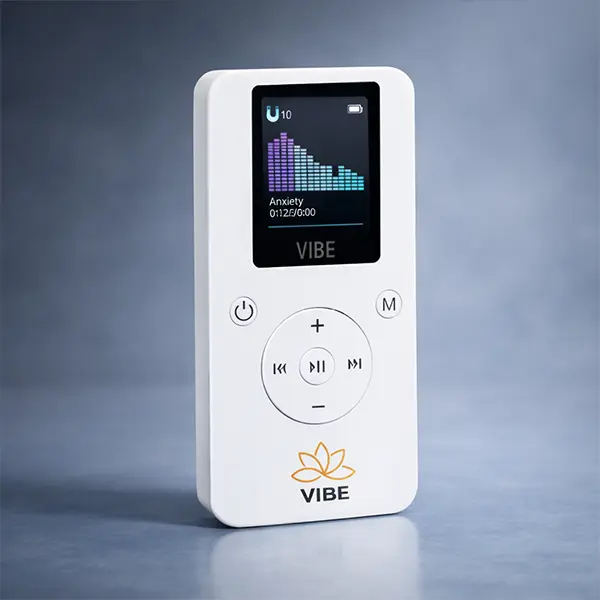
Anxiety
The protocol people reach for on the days the accelerator won’t let go. Pocket or lanyard, one button, and get on with your day.
Sleep
The protocol our customers mention most. Set it, put the VIBE on the nightstand or in the pillowcase, and let it run.
Neck & Back Pain
Dedicated protocols for the two places most of us carry the day. Put the VIBE where it aches — a pocket, a waistband, under a pillow.
Neuropathy
A protocol for hands and feet. Many customers run it in a sock or a glove, or simply set the VIBE beside them while they sit.
Brain Fog
The clarity-and-focus protocols, including the Brain Wave Alpha, Beta and Gamma states. A pocket session before the work that needs your head.
Those are the six most people start with. Sixty core protocols come on every VIBE, with a Brain Wave Expansion set alongside them. Run times range from about 26 minutes to two and a half hours; the device shuts itself off when the protocol ends.
Three Different Things Get Called “Vagus Nerve Stimulation.”
If you have been searching, you have probably seen all three treated as though they are the same thing. They are not — they differ in how they work, who they are for, and what they cost. Here is the honest map, including the one the VIBE is not.
Implanted VNS
A pulse generator placed under the skin of the chest by a surgeon, with a lead wound around the vagus nerve in the neck. Prescribed by a neurologist and used for epilepsy and treatment-resistant depression. Manufacturers include LivaNova and Medtronic.
This is not what the VIBE is. If a doctor is discussing an implant with you, that is a medical decision between you and your clinician. Nothing on this page is an alternative to it.
Transcutaneous (tVNS)
Sends a mild electrical current through the skin at the neck or ear. No surgery. You feel the pulses — tingling, throbbing, sometimes a muscle twitch — and you run timed sessions. Most need conductive gel or spray, and some require an app to set intensity. All of them do one thing.
Resonance frequency
No electrodes, no shock. A 2.6 oz device rides in a pocket or on a lanyard over the chest and delivers gentle PEMF resonance frequencies. The pulses induce a tiny current in the body — far too small to feel, but enough to travel through conductive tissue, which is how one pocket device gives whole-body coverage. One button. No gel, no app. Vagus Nerve is one protocol; there are 59 others behind it.
The VIBE is a general wellness product. It is not a medical device and is not a substitute for one.
Stimulation You Endure vs. Support You Forget Is There.
Every device below is non-invasive and available without a prescription. We have left the implanted devices out — those are a different category entirely, covered above. The last column is the one nobody else can fill in.
| Device | Price | How it works | What you feel | Ongoing cost | What else it does |
|---|---|---|---|---|---|
| VIBE | $299 | Resonance frequency, pocket or lanyard | Most people feel nothing | None | 59 other protocols — sleep, comfort, focus, recovery, pets |
| Pulsetto | from $278 | Electrical pulses at the neck | Tingling and pulsing during sessions | Conductive gel | Vagus nerve only |
| Truvaga 350 | $299 | Electrical, handheld against the neck | Tingling and pulsing during sessions | Replaced after 350 sessions | Vagus nerve only |
| Truvaga Plus | $499 | Electrical, handheld, rechargeable | Tingling and pulsing during sessions | Conductive spray | Vagus nerve only |
| WAVwatch 2.0 | $697 | Audible sound frequencies, worn on the wrist | Tones and vibration you can hear and feel | None | Sound-frequency library |
| Cold plunge | $150–$5,000+ | Cold water immersion | Intense cold, every session | Ice or a chiller | Cold |
Competitor prices are the manufacturers’ published figures as of August 2026 and change often — please check their sites for current pricing. Comparison covers non-invasive consumer devices only.
Three Steps. Then It’s Just Part of Your Day.
Charge it
USB-C, cable and adapter in the box. A full charge runs about five hours at full power. The magnetic field tester is in the box too, so you can see it working.
Pick Vagus Nerve
One button scrolls the sixty protocols. Choose Vagus Nerve on its own, or run Brain Wave Alpha followed by Brain Wave Theta — the sequence our support team recommends for vagal tone.
Wear it, or pocket it
On the lanyard it rests over the chest near the vagus nerve cluster. In a pocket it works just as well. The VIBE shuts itself off when the protocol finishes. Tomorrow, pick a different one.
Engineered by the Space Shuttle’s Chief Engineer. Gentle on Purpose.
Mark Fox — rocket scientist, U.S. Army veteran, professional skeptic — has spent 24 years shrinking resonance frequency therapy from $30,000 clinic machines into devices people actually use. The VIBE is the one that did it: sixty protocols in a device the size of a deck of cards, with one button and nothing to subscribe to.
The intensity is deliberately low. As one of our practitioner reviewers puts it: gentle can be more powerful. If a device is comfortable enough to carry every day, it gets used every day — and consistency is what your nervous system actually responds to.
The Device That Built Resona Health.
“Gentle can be more powerful. Your VIBE unit fits this idea beautifully. A cost-effective tool that is affordable, yet powerful. Subtle, yet so powerful.”Dr. Rebecca Rhodes, DNM
Vagus Nerve Support Today. Whatever You Need Tomorrow.
Sale price applied automatically at checkout. One-time purchase — no subscription, ever.
- ✓VIBE PEMF device with lanyard — 2.6 oz, one-button operation, 60 protocols on the device, patent pending
- ✓In the box: USB-C cable, AC adapter, lanyard and tool, magnetic field tester, instruction card
- ✓Rechargeable: about five hours at full power, eight at half
- ✓Free worldwide shipping · usually ships same day · 1-year warranty
The 30-Day Money-Back Guarantee. Run it daily for a month. If your days don’t feel different, send it back for a complete refund — no restocking fee, no interrogation. — Mark
Straight Answers. No Hype.
Is this the same as an implanted vagus nerve stimulator?
No. An implanted VNS device is a prescription medical device placed surgically by a doctor, with a lead attached to the vagus nerve in the neck, and it is used for conditions like epilepsy and treatment-resistant depression. The VIBE is a general wellness product you carry in a pocket or wear on a lanyard. It involves no surgery, no prescription, and it is not a substitute for medical treatment. If you are considering an implant, that is a conversation for you and your neurologist.
How is this different from the electrical vagus stimulators?
Devices like Pulsetto and Truvaga use transcutaneous electrical stimulation — a mild current through the skin at the neck — which is why you feel tingling or pulsing during sessions, and why they need conductive gel or spray. The VIBE uses low-level PEMF resonance frequencies instead. They do induce a tiny current in the body — that is how a single pocket device reaches everything — but it is so low that nobody feels it: no buzzing, no tingling, nothing to endure. And it carries 59 other protocols they do not.
Which protocol do I use for the vagus nerve?
There is a dedicated Vagus Nerve protocol on the device. Our support team also recommends the two-step sequence of Brain Wave Alpha followed by Brain Wave Theta for vagal tone. Try both across a couple of weeks and keep the one your days respond to.
Will I feel anything?
Most people feel nothing at all — the energy level is deliberately low. That’s not a limitation; it’s the design philosophy. A device gentle enough to forget you’re carrying is a device you’ll actually use daily, and consistency matters more than intensity. The magnetic field tester in the box shows you it is running.
Where do I wear it?
On the included lanyard, over the chest, or in any pocket. PEMF travels through the body’s conductive tissue, so the effect is never limited to where the device sits. For sleep, many customers set it on the nightstand or slip it into a pillowcase.
What’s the difference between the VIBE and the VaguVibe?
The VaguVibe is a 1.5-ounce pendant that does one thing continuously: daily vagus nerve support, no menus, one button. The VIBE is the full device — the same technology with sixty protocols you choose between. If vagus support is the only thing you want, the VaguVibe is on our shop. If you want the vagus protocol and everything else, you want the VIBE.
Any subscriptions or hidden costs?
None, ever. $299 once. No app required, no membership, no unlock fees. That’s a Resona Health policy across every device we make.
Who do I talk to if I have questions?
Real people — Gabby, Kelly, Paul, Stephanie, Amanda, Mark, and the team. Email info@resona.health or call 1-321-221-5560 and an actual human answers — before and after you buy.