
MagnaWave Alterative for Horses

For horse owners who’ve had MagnaWave out to the barn
You didn’t stop because it wasn’t working.
You stopped because it was $125 a session, the practitioner comes out every other week, and your horse needed it on a Tuesday. If there are two horses in the barn, it was $250.
Free worldwide shipping · 30-day money-back guarantee · 1-year warranty
The arithmetic nobody puts on a sales page
Three sessions. That’s the whole argument.
We’re not going to estimate what you pay. MagnaWave publishes it themselves: a normal full-body equine session is $125, and their own support page notes that prices vary by practitioner and state. Their number, their caveat. Run the tally yourself.
One practitioner session
|
$125
Two sessions
| |
$250
Three sessions
| | |
$375
VIBE + EquiVibe Band
Yours. Once.
Yours. Once.
∞
$328.95
Somewhere in the third session, owning costs less than renting. Every session after that is free, happens on your schedule, and doesn’t require anyone to load a trailer or drive out to your barn. Session pricing above is MagnaWave’s own published figure for a normal full-body equine session; as they note, pricing varies by practitioner and state.
Where this device actually came from
It starts with a dog who couldn’t manage the stairs.
Mark Lee Fox spent his career as a Chief Engineer on the Space Shuttle program. A large part of that job was knowing what particular frequencies do to a physical structure — which ones pass straight through it, which ones tear it apart, and why the difference has almost nothing to do with how much power is behind them.
Then his own dog, Lechien, got old.
Utah, 2002. She stood at the bottom of the stairs and cried. She had climbed those stairs ten thousand times and had never once made that sound. The diagnosis came the same day: arthritis, and not in one joint — through her whole spine.
A veterinarian friend told him there was a lady in Oregon with a machine that was reversing arthritis. He was a rocket scientist. Everything he knew said that was nonsense. But she was his dog, so he made the appointment and planned the drive.
They never made it. Lechien got so sick, so fast, that his vet told him not to put her in the car and do that to her.
He never found out whether that machine would have helped her.
What made him angry was where the technology lived — locked inside clinics, in machines the size of beer kegs, priced at twenty to thirty thousand dollars. Real relief existed, for whoever could drive to it and afford it. Lechien couldn’t survive the drive.
So he asked a different question. Not how do we make this more powerful. Everyone was already answering that one. He asked: how do we make it affordable enough, small enough and simple enough that the owner can just do it themselves?
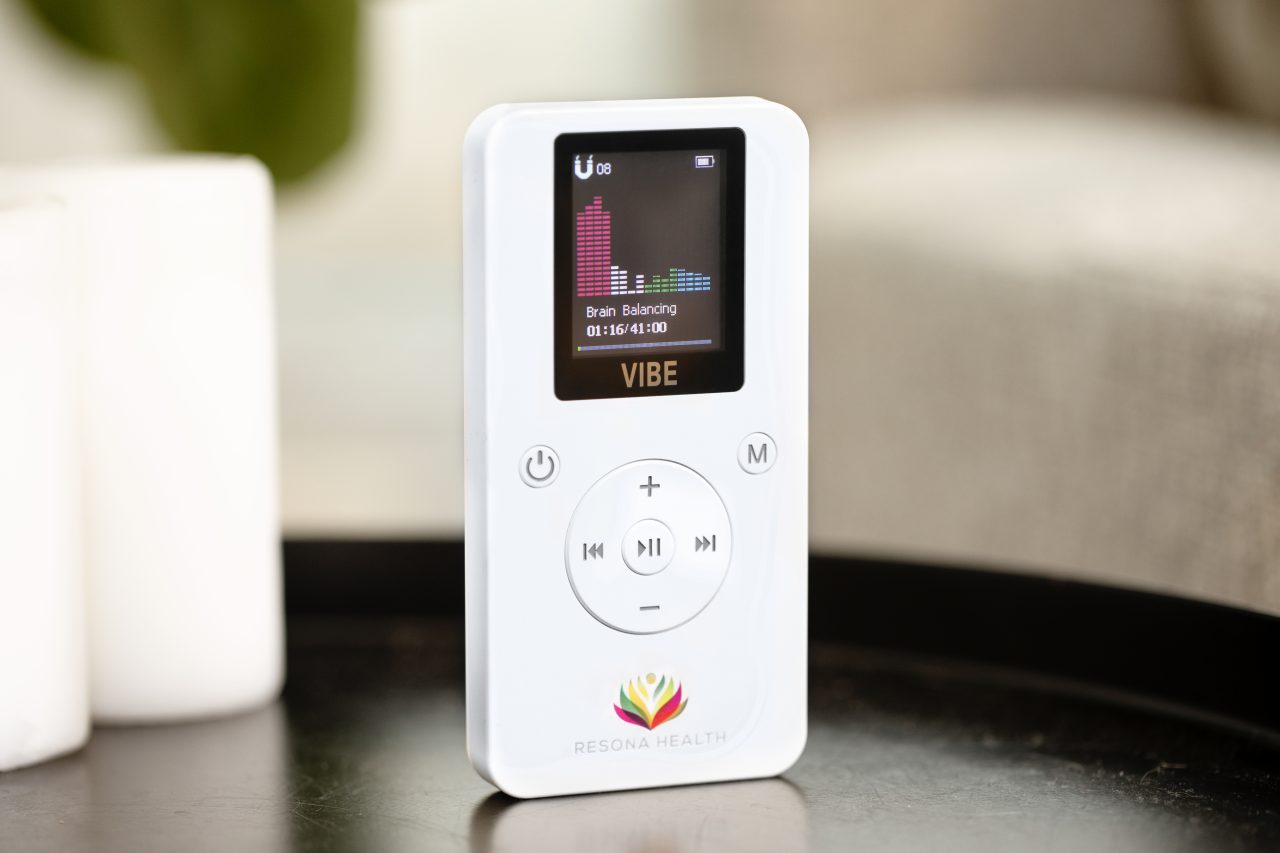
Power was never the active ingredient, so there was nothing to give up by leaving it behind. Twenty-four years and an eight-foot pile of failed coils later — his wife eventually threw the pile out — the answer weighed 75 grams and fit in a shirt pocket, with 60 core protocols on it, in the hands of the person who actually sees the animal every day.
That device is now used by more than 30,000 people — and, it turns out, on a great many horses.
The honest part
This is not a smaller MagnaWave. It’s a different tool.
Anyone who tells you a pocket device does exactly what a high-powered machine does is hoping you won’t ask a follow-up question. So here is the comparison written the way we’d write it if we sold both.
| High-powered PEMF (practitioner) | Resona VIBE + EquiVibe Band | |
|---|---|---|
| Intensity | Far higher — strong enough to drive visible muscle contraction, and able to cover a large body in one visit. | Low intensity, deliberately. It works by resonance, not force — paired frequencies rather than raw power. More intensity is not more therapy. |
| Who runs it | A certified practitioner, with training and hands-on experience reading your horse. | You. Pick the protocol, put it in the band, walk away. |
| Cost | $125 for a normal full-body session by MagnaWave’s own published figure — ongoing, and per horse. | $328.95 once. No session fees. No subscription. |
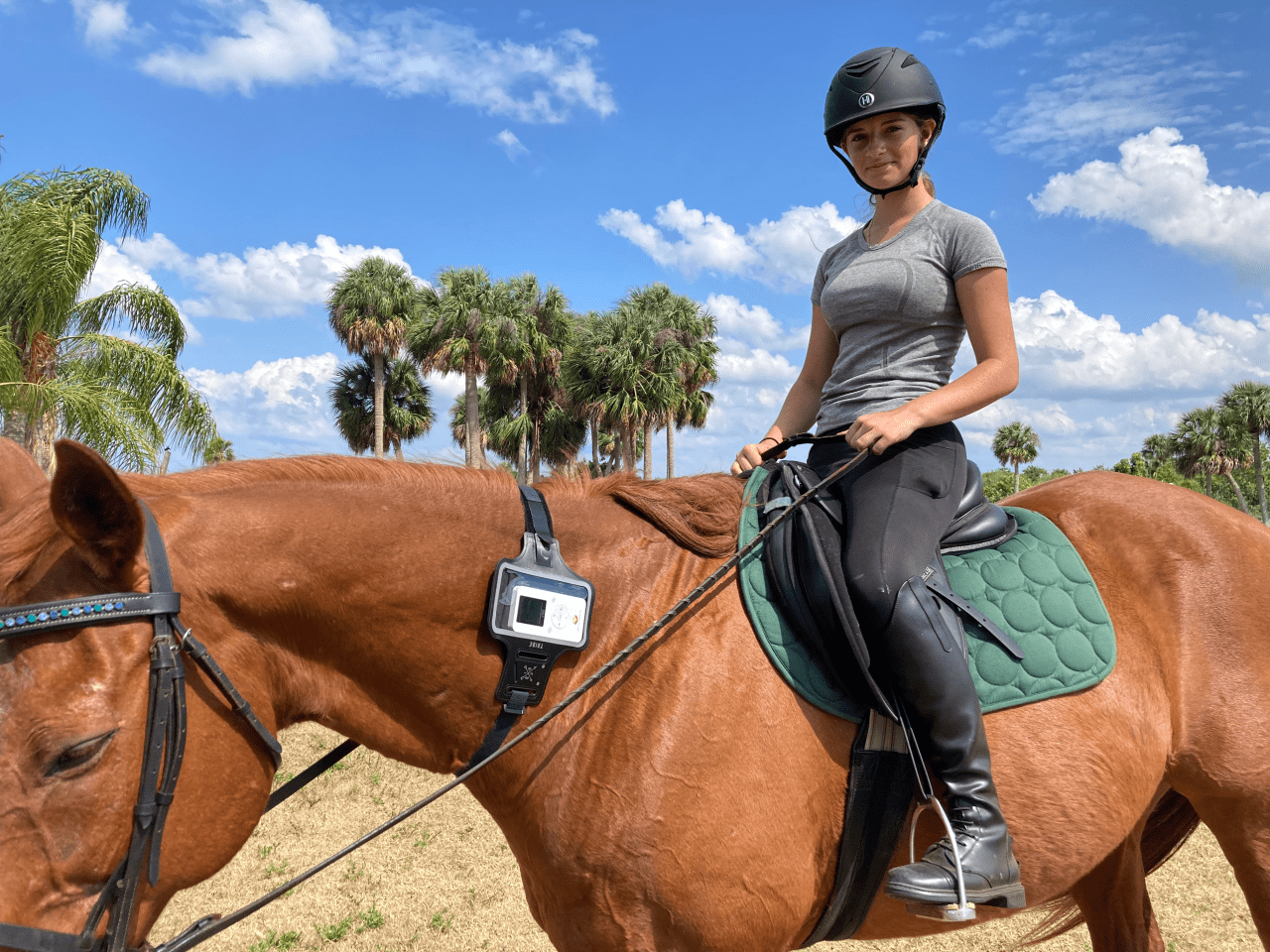
| Availability | Whenever the practitioner’s route brings them to you. | Every day, and the horse doesn’t have to stand still for it — out grazing, loose in the paddock, in the trailer, at a show, or under saddle while you ride. |
| Best used for | Intensive work on a specific problem. Deep tissue coverage across a large body. | Daily maintenance between visits, and the days a practitioner isn’t coming. |
| How many horses | Billed per horse, per session. | One device, every horse in the barn, plus the dog, plus you. |
If you can afford a practitioner weekly, keep them. They are good at this. Most owners can’t — so the real choice isn’t high-powered PEMF versus the VIBE. It’s something most days, or nothing most days.
In practice
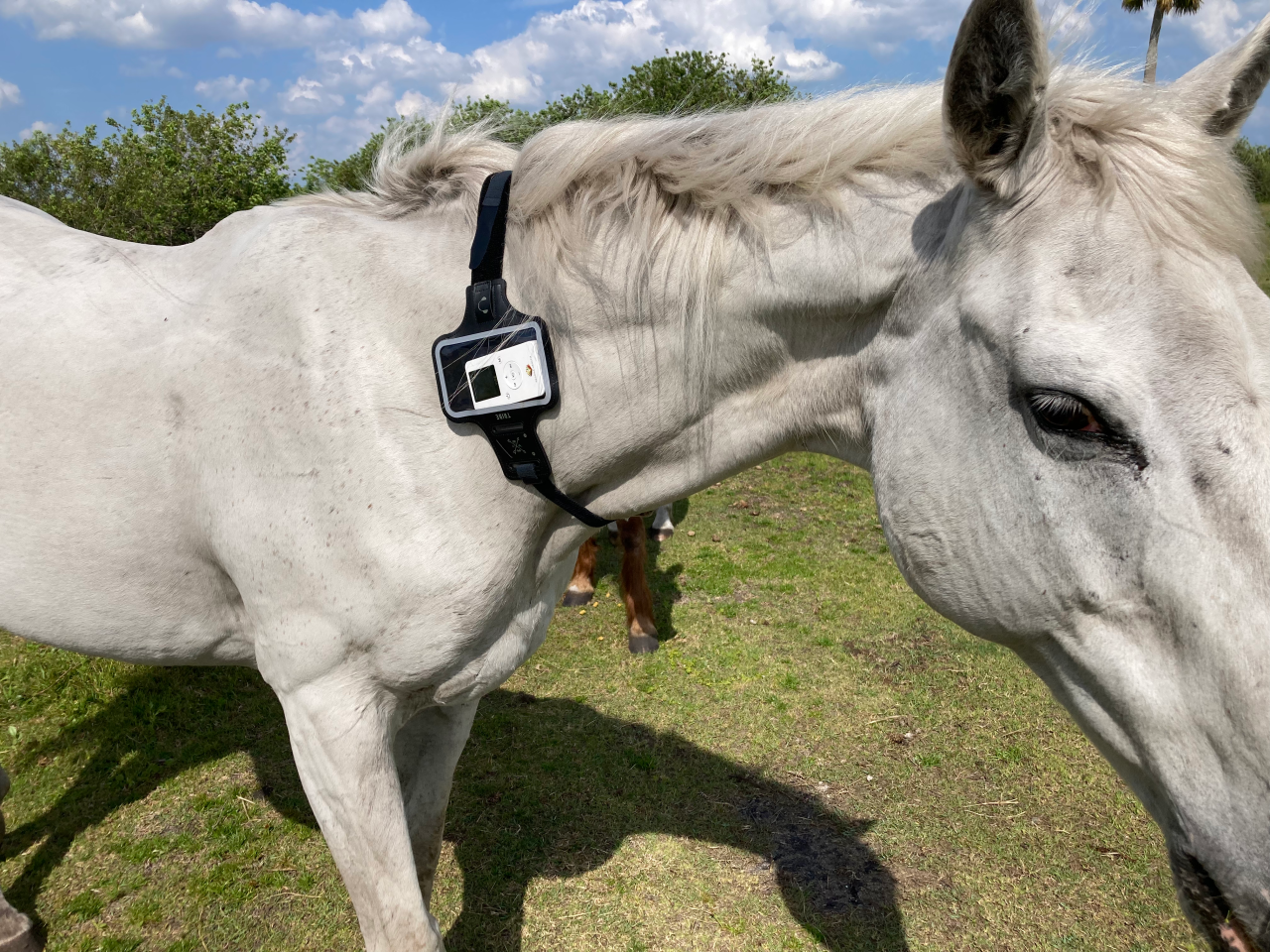
The band goes at the base of the neck. Then you go do chores, or go for a ride.
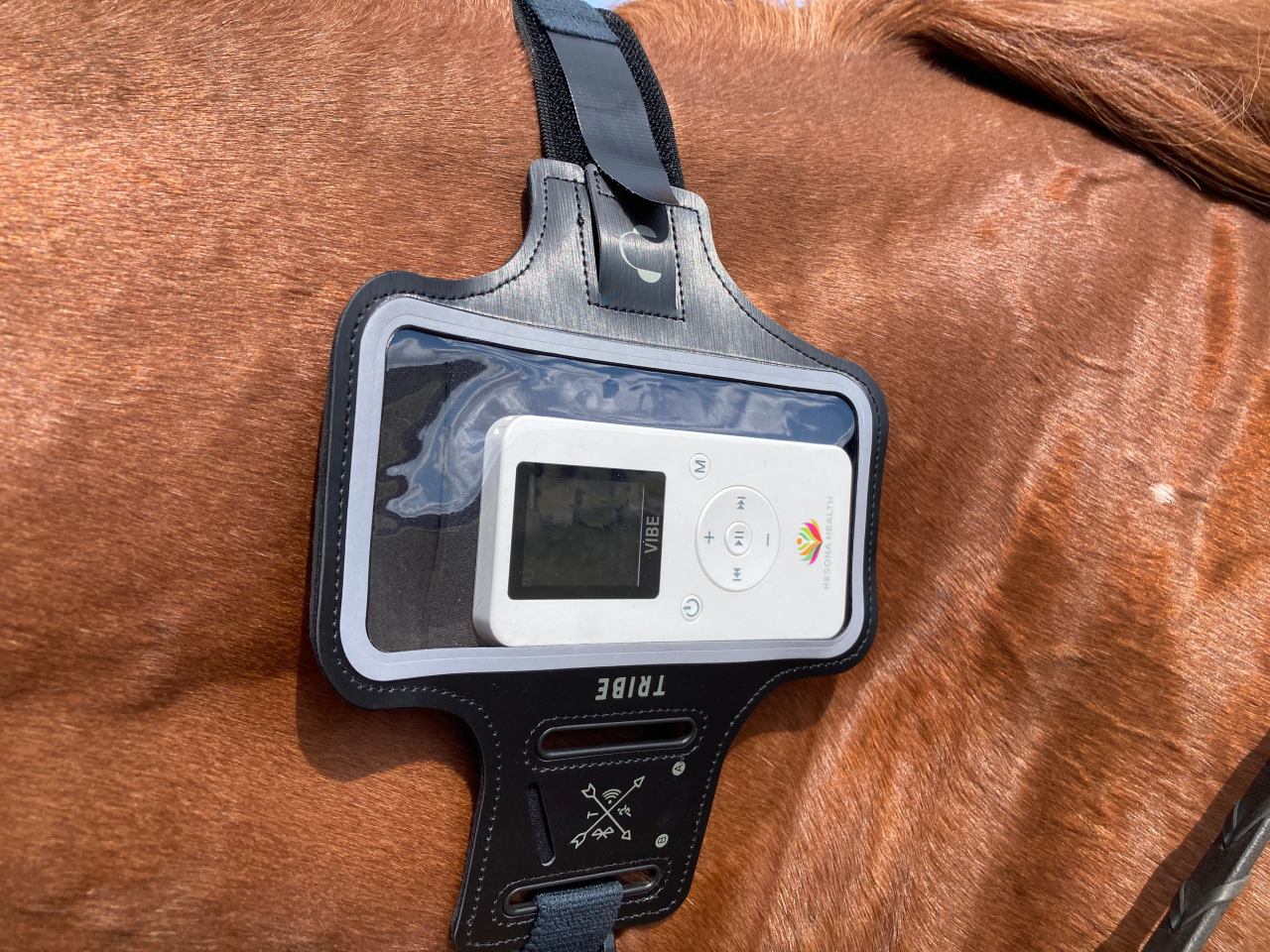
The EquiVibe Band holds the VIBE against the upper neck, where the vagus nerve runs close to the surface — the same placement principle used in human vagus nerve therapy. It stays on through rest, grooming, trailering, or turnout.

Owners most often reach for it in these situations:
Before the thing that winds him up
Trailer loading. The farrier. The vet. Clipping. Storms. Run Vagus Nerve or Relax and Balance ahead of the event rather than during the meltdown.
After hard work
Relax and Balance, then General Inflammation — the combination the manual recommends for bringing a horse down off exertion and easing next-day soreness.
Stiff joints and older horses
The Arthritis protocol, for the seniors and the pasture-sound retirees who aren’t on anyone’s appointment book anymore.
Strains and tendons
The Tendinitis protocol supports circulation and collagen production in soft-tissue injuries — the ones that otherwise mean weeks of standing around.
Cuts, scrapes and slow-healing wounds
Wound Healing supports the body through the stages of closing a wound. Mitzy T. mentions it above, on an older mare, in winter.
Gut and digestion
Constipation plus vagus nerve work. The vagus runs the “rest and digest” side of the nervous system, which is why the neck placement matters for the gut.
60 core protocols and 70 expansion protocols are on the device. It works alongside your veterinarian and your farrier — never instead of them. If something is wrong with your horse, call your vet.
From owners
“My fidgety horse stood still for the first time in his life… head bobbing gone, totally relaxed. Can’t wait to try this in the trailer!”
Shari B.
“Older mare’s wound healing fast in winter. Mini horse with fibromyalgia perked up after Day 1. Using it on all my animals and myself. Loving the portability!”
Mitzy T.
“Gentle can be more powerful. Your VIBE unit fits this idea beautifully. A cost-effective tool that is affordable, yet powerful. Subtle, yet so powerful.”
Dr. Rebecca Rhodes, DNM
These are individual experiences shared by Resona Health customers. Results vary from horse to horse, and nothing here is a promise of any particular outcome.
30,000+Customers
60 + 70Core & expansion protocols
600+Peer-reviewed PEMF studies
30 daysMoney back, no questions
The objection we get most
“That thing is too small to do anything to a 1,200-pound animal.”
It’s a fair objection, and the answer is straightforward: no, it isn’t a high-powered machine. It doesn’t need to be.
The objection assumes PEMF works by force — that a bigger animal needs a bigger dose, the way a bigger room needs a bigger heater. It doesn’t work that way. It works by resonance. Turning up the volume on a radio will not bring in a station you aren’t tuned to. Being on the right frequency will.
And this is where the VIBE stops resembling other devices. Most of them run a sweep — climbing through a broad range of frequencies on the assumption that something in there will be useful. The VIBE doesn’t sweep. It runs matched pairs. One frequency is aimed at where the condition is. The other is aimed at what’s wrong with it. Two notes at once, and the second one is the reason a sweep can’t do the same job.
It also doesn’t have to sit on the sore spot. The signal couples into the horse through the conductivity of the coat and resonates with the water the body is largely made of. And placed at the neck, it reaches far beyond the neck — the vagus nerve runs from the brainstem down through the chest and abdomen, so stimulating it there carries through the whole animal.
The pair changes every one to four minutes. At any single moment it’s a chord. From the first minute to the last, it’s a composition.
A song the body hears and your ears don’t.
That’s what a protocol is. There are 60 of them on the device and 70 more in the expansion library — and none of it depends on being loud.
High-powered machines are strong enough to make muscle visibly contract. That is the same basic idea as a TENS unit — pushing enough electrical energy into a muscle to make it flex on its own, without the horse doing any work. It is a real effect and there are practitioners who use it well. But it is not resonance, and it is not what the VIBE is doing. More intensity is not more therapy.
And it isn’t a long, cumbersome procedure. A session averages about 40 minutes — across the full library they run from roughly 30 minutes to two and a half hours — and three to four sessions a week is the usual rhythm. It does not need to be run every day. Because the device comes off one horse and goes onto the next, you can work through several horses in a day without booking anything.
You don’t have to take our word for any of it. That’s what the 30-day guarantee is for. Put it on your horse for a month. If nothing changes, send it back and we refund every cent.
The offer
The complete equine setup
$328.95
$428.95
Save $100
VIBE + EquiVibe Band Bundle
- Resona VIBE PEMF device — 60 core protocols, 70 expansion protocols
- EquiVibe Band — positions the device at the upper neck, hands-free
- USB-C charging cord, AC power supply, lanyard and tool, magnetic field tester
- Free shipping, worldwide
- 30-day money-back guarantee and a 1-year warranty
- No session fees. No practitioner call-out. No subscription.
Free shipping worldwide. 30-day money-back guarantee. 1-year warranty.
Your horse doesn’t need a bigger machine.
He needs the one that’s already in the barn.
All Resona Health products are FDA general wellness devices. These statements have not been evaluated by the Food and Drug Administration. This product is not intended to diagnose, treat, cure, or prevent any disease in humans or animals.
PEMF is not a substitute for veterinary medicine. Always consult your veterinarian about your horse’s health, and never delay or discontinue veterinary care in favor of any wellness device. Customer statements on this page describe individual experiences; results vary.
MagnaWave® is a registered trademark of MagnaWave PEMF. Resona Health is not affiliated with, endorsed by, or sponsored by MagnaWave. Session pricing referenced on this page is MagnaWave’s own publicly published figure for a normal full-body equine session, accurate to the best of our knowledge at time of writing; as MagnaWave notes, practitioner pricing varies by state and provider. Product comparisons reflect our good-faith description of two different categories of device.
© 2026 Resona Health. All rights reserved.