
Lauras Story V2

Laura Giles · Rooted Recovery
It runs during the hour.
Laura Giles is a therapist who works with PTSD and complex PTSD. There is a VIBE in her office, and it is on while she works. This is what she has watched happen before a session ends — and what she has not.
The room before the device
I work with people with PTSD and complex PTSD. Healing takes time and they want fast relief, natural solutions, and something easy. The VIBE takes care of all those things.
Laura GilesThat sentence is the whole tension of trauma work in one line. The therapy takes as long as it takes. The person sitting across from you wants something that helps this week, doesn’t come from a pharmacy, and doesn’t require a new discipline they have to keep up on their worst days.
Laura already owned a PEMF device when she saw the VIBE.
I own a different PEMF device and came across an ad for the VIBE. It claimed to be better and was a whole lot cheaper and smaller, so I wanted to know more about it. I contacted Mark Fox. He was very accessible and forthcoming with lots of help. Since the VIBE had a 30 day money back guarantee, I wasn’t risking anything to try it, so I did.
Laura GilesWhat she sees inside one session
Most people who own one of these use it alone — in a pocket, at a desk, in bed. Laura runs hers in the room, during the hour, with the client. So she is watching the same person at the start of the session and at the end of it, which is a vantage point almost nobody else has.
I don’t have any chronic issues, but travel can disrupt my sleep and bathroom regularity. VIBE is very good for that. I use it in my office with clients during one hour sessions. By the end of the session, I’ve seen lessening or complete relief of neck pain, complete relief of tinnitus, and lessening of anxiety.
Laura Giles0:00
Start of the session
- The client arrives as they arrive.
- The VIBE is on in the office.
- The work begins.
1:00
What Laura has seen by the end
- Neck pain lessened, or gone.
- Tinnitus gone.
- Anxiety lower than when they walked in.
These are Laura’s own observations from her office. They are not a study, and they are not a promise about anyone else’s hour.
Why it can sit in a therapy session at all
Nothing about a talk-therapy hour survives a device that shocks people or contracts their muscles. A TENS unit puts out at minimum a thousand times the energy the VIBE does, and it makes you twitch doing it. You could not run one while someone is telling you the hardest thing that ever happened to them.
The VIBE runs the other direction. Therapeutic PEMF sits between 1 and 1,000 hertz — on a logarithmic scale next to the phone in your pocket, that is effectively zero. You do not feel it. It works through clothing. The claim, which has been measured repeatedly, is that a cell’s charge rises and its fuel supply goes up. Recharged batteries and more fuel. The body decides what to do with that.
It does not run at a single frequency. It runs pairs that change every one to four minutes — a chord, not a note — and each protocol is a different song built out of roughly 35 years and 8,000 people’s worth of trial and error. Sixty of them, listed alphabetically. Scroll, press play, put it in a pocket. That is the entire procedure, which is why it can share a room with something as delicate as the work Laura does.
Bigger is better is taught by exactly one person, and he is the one selling the fifteen to thirty thousand dollar machines.
Mark Fox, founder, Resona Health
What it has not done
Resona Health runs the largest PTSD study in the world using energy therapy, and reports a 98% success rate. Laura works with PTSD every day. So she was asked, directly, what had been slower than expected or hadn’t worked at all — and told not to skip it.
Since I work with PTSD and the claim for PTSD relief is very high, I was hoping that it would work better for that. I haven’t had any clients get cured from PTSD, but they may not be using it regularly or the study may not be looking at complex PTSD, which is what most of my clients suffer from. VIBE helps with the symptoms, but it hasn’t been a cure.
Laura GilesThat stays on the page, exactly as she wrote it. A therapist who says “it helps the symptoms, it hasn’t been a cure” is telling you what she has seen and where the edge of it is. Her two guesses about why — that clients may not be using it regularly, and that complex PTSD may not be what the study is looking at — are hers, and they are guesses, and she says so.
The other twenty-three hours
An hour a week in Laura’s office is not the dose. The test Resona Health puts on it is three to four sessions a week, about forty minutes each, for thirty days. If it hasn’t helped by then, it isn’t going to — or the protocol is wrong for what is actually going on. Either way you know inside a month.
Asked whether there was one client where it changed the arc of the work they were doing together:
No, not one in particular. The ones that use it regularly benefit the most. I think that for most issues, effectiveness comes down to whether or not the person uses it, uses the most effective protocol, and uses it correctly (not too much or too little).
Laura GilesWhich is the same answer from a different angle. The hour in the office is where she watches it. The rest of the week is where it works or doesn’t.
Human beings are also bad witnesses to their own improvement. A chiropractor Mark has known since kindergarten videotapes every new client, because they arrive on a walker, then a cane, then carrying a lap dog — and by then they will tell you they could always do that. Write down where you are on day zero. You will not remember it on day thirty.
Why her name is on it
Asked when she started recommending it to clients, and what made her comfortable doing that:
Immediately. I talked to Mark, liked him, and trusted him. I trusted the money back guarantee. A few clients have returned it and had no issues, so it seems to be a no brainer to at least try it. Nothing works for everyone, but if you can have relief without drugs or side effects, I don’t know why you wouldn’t try.
I have given one to both my parents. My father has lots of aches and pains and sleep issues. The VIBE helps with both.
Laura GilesThe part to read twice is the middle. A few of her clients sent it back, and nothing went wrong when they did. That is why she is comfortable saying try it: not because it works for everyone, but because finding out costs you nothing.
What is in the shop
The VIBE is the one in Laura’s office. The rest of the line does different jobs.
-
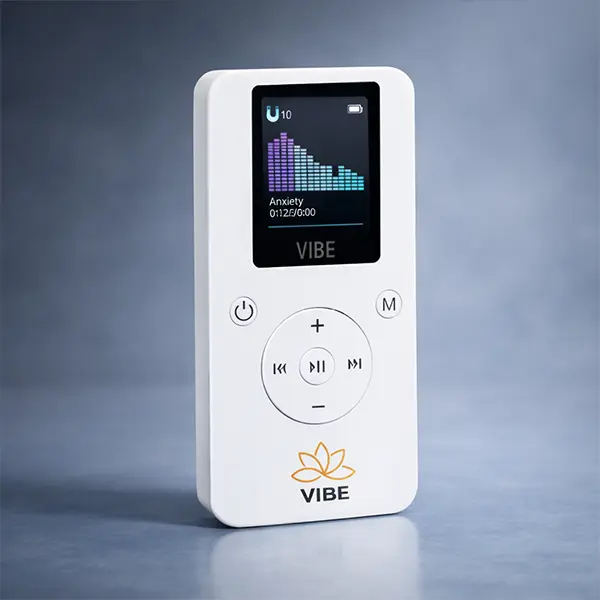 VIBE
Sixty protocols. Works through clothing. The same device for people, dogs and horses.
$299$399See the VIBE -
 VaguVibe
Vagus nerve only. One on button, one off. Worn over the heart, not at the neck, and it does not shock you.
$249$349See the VaguVibe -
 BlueVibe
40 hertz light and 40 hertz PEMF together, for cognitive impairment and memory. Has to touch skin. One button.
$349$499See the BlueVibe -
 Dog Vibe Vest Bundle
A VIBE with a vest that carries it. Bandana for smaller dogs, neck band for horses.
$328.99See the bundle -
 FulVic Acid
The only supplement in the line. Meant to run alongside protocols, in the glass or the bowl.
$44.95See FulVic Acid -
 RejuvaSync Cream
Quad-peptide cream. Run the anti-aging protocol against it, then use it at night.
$39.95See RejuvaSync -
 Kario Wellness Watch
For tracking your thirty days. Sleep first, heart rate variability second.
$149See the watch
Thirty days to find out
The device in Laura’s office. Three to four sessions a week, forty minutes each, and you will know inside a month. If it didn’t do anything, send it back for your money.
Resona Health is the rare company in this field with a phone number and people who answer it.
Important information. The VIBE, VaguVibe and BlueVibe are FDA general wellness devices. These statements have not been evaluated by the Food and Drug Administration. These products are not intended to diagnose, treat, cure or prevent any disease.
Individual results vary. The experiences described on this page are those of the individuals involved and are not a guarantee that anyone else will have the same outcome. Nothing here is medical advice.
Always consult a licensed physician before beginning any new wellness practice, particularly if you are pregnant, have a pacemaker or other implanted electronic device, or are managing a diagnosed medical condition. For animals, consult a licensed veterinarian. Do not stop, start or change any prescribed treatment based on anything you have read here.
Affiliate disclosure. Laura Giles is a Resona Health affiliate and earns a commission on purchases made through the links on this page, at no additional cost to you.