
Davids Story V1
David's story
He limped for a week after every hockey game.
Then he laced them up and played again. For years. This is the story of the week that ended it, and the 11.5-mile hike that proved it.

David JohanssonFormer neurofeedback practitioner. Retired hockey player. Runner, hiker, and the guy who tested the device on himself before he'd let a client near it.
Achilles tendonitis. Left heel. Years of it.
David had tried everything. Physical therapy. Stretching. Not stretching. Nothing moved it.
But he played hockey, and hockey doesn't wait for your heel. So the routine became the routine: play a game, limp for a week, lace them up for the next game, play through it, limp for another week.
That is not a story about toughness. It's a story about running out of options and deciding to live with the one you've got.
He didn't buy it for his heel.
About two and a half years ago, David and his wife Shari were running a neurofeedback practice. Brainwaves, EEG, measurement. If something claimed to change the nervous system, they wanted to put electrodes on it and see.
David caught Resona Health's founder, Mark L Fox, on a webinar, and reached out with a proposal: let's measure what your device is actually doing to the brain, and if it holds up, we'll use it with clients.
So he ordered a VIBE for the practice. And then he did what any careful practitioner does before handing something to a client.
He tested it on himself first.
About a week.
He ran the Tendonitis protocol on the heel, alternating with General Inflammation, back and forth, for roughly a week.
Then one morning he noticed the thing you notice when something is missing: no stiffness.
He didn't trust it. So he walked out to the field next to his house and ran sprints. Not a jog. Sprints, on a heel that had punished him for years.
Felt great.
The next day he played a hockey game. Still felt good the day after that.
"I mean, it felt miraculous. It really did. I was elated. It was the best feeling ever."
David, on the week the limp stopped
That was his first experience with the device. It was supposed to be an experiment for the clients. It turned into the end of a years-long problem instead.
It was March. Good timing.
David also had severe seasonal allergies. The device arrived right as the season did, so he added the Allergy protocol to the rotation, often running it and General Inflammation on the same day. He found the two together moved things faster than either one alone.
Yearsof limping a week after every game
5allergy pills the whole first season with the VIBE
0allergy pills this year
That first spring, he made it through the season on about five allergy pills. This year, none.
The Ron rule.
When David told Resona Health's founder, Mark L Fox, the story about his heel, Mark told one back. He'd given a device to a friend and business partner named Ron. Three months later, Ron called him up out of nowhere.
"So this thing is insane. I've not breathed this well since I was like twelve years old."
Ron, three months after Mark gave him the device
Mark asked the obvious question: you're just now using it? I gave it to you three months ago.
Yeah. Last night was the first time.
David, the guy who tested his on himself the week it arrived, didn't need the lesson. But it's worth writing down for everyone else: devices do not work if you don't use them. The one in the drawer has a zero percent success rate.
Eleven and a half miles, up and down the Ozarks.
David retired from hockey last year. A dislocated shoulder and another concussion. He decided that was enough.
What he didn't retire from was moving. He's running and jogging more now, the exact kind of pounding that used to wake the heel up.
This year he and Shari took a month in Arkansas. One day they hiked eleven and a half miles up and down the hills with the dogs, one of them eleven and a half years old, the other three.
David is 62. He'll be 63 in November.
His words: the dogs were suffering more than he was. He did great. No problems at all.
What a measurement guy does with a result like that.
David and Shari have since sold the practice. He does training, consulting, and coaching now, and he's building a site where he writes about every product he's tested over the years. The VIBE is at the top of that list. His review covers his own experience, how PEMF works, why a device this small does what it does, and how it compares to units he's tried that cost many thousands of dollars.
He also brings a neurofeedback habit with him: people forget how bad they felt. In the practice, every ten sessions he'd check a client's top ten symptoms, because someone will tell you "I'm not improving" in the same breath as "I only had three meltdowns last week instead of one every day."
So when he coaches someone through the VIBE, he tells them to pick something they can actually measure. The easiest one is sleep. Shari started with the Sleep protocol herself, and it helped her considerably.
And he starts people slowly. A sensitive client gets thirty minutes, not a marathon, until he knows how they respond.
- TendonitisThe one that ended the week-long limp.
- General InflammationAlternated with Tendonitis on the heel; paired with Allergy in the spring.
- AllergyFive pills the first season. Zero this year.
- SleepShari's protocol. Run about an hour before bed, not in bed.
One thing Mark L Fox told David that's worth passing on: run every protocol start to finish. The VIBE doesn't play a single frequency; it plays pairs that change every one to four minutes, like chords in a song. Stopping halfway is like cutting your favorite song off in the middle. Finish the song.
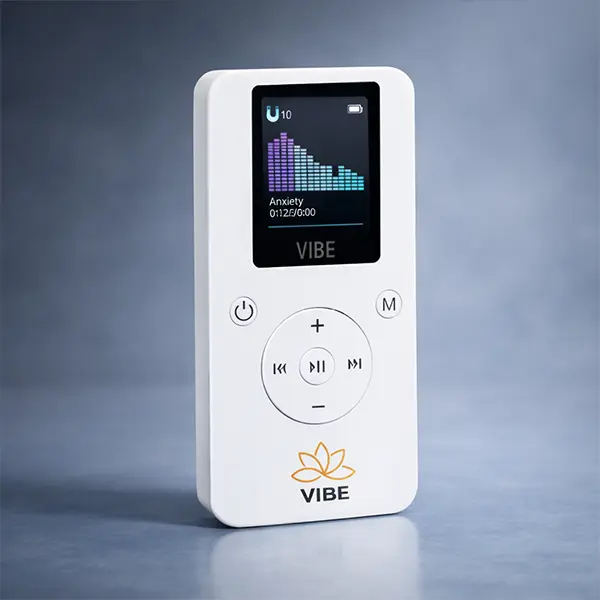
The VIBE, from Resona Health
$299 $399
A pocket-sized PEMF device with 60 core protocols and 70 expansion protocols built in, including the four above. One button. No app, no subscription, nothing to figure out.
- Fits in a pocket or wears on the included lanyard, and works through clothing
- Rechargeable, about 5 hours per charge at full power
- Safe for people and pets
- Free shipping worldwide
- 30-day money-back guarantee and 1-year warranty
David's heel took about a week. You get 30 days. If it does nothing for you, send it back for a full refund.
More from Resona Health.
The VIBE is where David started. Two more from the same company, both one-button, both wearable, both built for the nervous-system side of things a former neurofeedback guy tends to ask about.

BlueVibe
$349 $499
PEMF and blue light, both pulsed at 40 Hz, in a one-button wearable for the wrist or the back of the neck. Made for focus, memory, and mental clarity. Forty hertz is a brainwave frequency, which is exactly the kind of thing David used to measure for a living.
See the BlueVibe
VaguVibe
$249 $349
A pendant worn over the chest that gently supports the vagus nerve with low-level PEMF all day. No menus, no sessions, nothing to feel. Wear it and go. If you want a number to watch, heart rate variability is the one David would tell you to track.
See the VaguVibeA device meant for the clients never made it to the clients first.
A guy who limped for a week after every game. A week on a heel that had ignored physical therapy for years. Sprints in a field. A hockey game the next day. And an 11.5-mile hike in the Ozarks at 62, with the dogs bringing up the rear.
Don't be Ron. Take it out of the drawer.
The VIBE is an FDA general wellness device. These statements have not been evaluated by the Food and Drug Administration. This product is not intended to diagnose, treat, cure, or prevent any disease. Individual results vary.
Nothing on this page is medical advice. The experiences described are David Johansson's own, shared as a personal story. Protocol names such as Tendonitis, General Inflammation, Allergy, and Sleep are the names of settings on the device, not claims of treatment for any condition. Talk to your physician about any health concern or medication change, and consult your veterinarian before using any device on a pet.
David Johansson is an independent affiliate of Resona Health and earns a commission on purchases made through the links on this page, at no additional cost to you.