Free Shipping on All Orders60 Healing Frequency ProgramsBacked by 40+ Published StudiesSafe for People & Pets30-Day Money Back GuaranteeFree Shipping on All Orders60 Healing Frequency ProgramsBacked by 40+ Published StudiesSafe for People & Pets30-Day Money Back Guarantee
Two horses, and Christy’s bag. One horse was getting his session. The other one went over to the bag and stuck his nose in it.
Christy Garavetto heard it before she saw it. “I could hear this clicking back and forth,” she says. “So I look over and I’m like, what are you doing? And he’s … got the VIBE. He’s clicking the buttons.”
“Like it’s my turn.”
Christy Garavetto, on the horse in her bag
So she interrupted the other horse’s session and put it on him. And then, she says, he walked away: “It’s like I’m fine. I got mine.”
She keeps two in that bag. “I always have two of them in there,” she says. The horses seem to know it. When she arrives, “they’ll root through my bag. Where’s mine?”
Christy at work in the paddock, with a VIBE on the black horse, and company.
Who she is
She works on horses, dogs and cats.
Christy runs a business called Interactive Equine Bodywork. She works on horses, dogs and cats. Her background is energy work, Reiki and massage therapy, and she has used PEMF in her business with horses for a long time.
She also has a big PEMF machine. She loves it, and she says it has gotten some horses out of dire experiences, with the vet involved. But it was not affordable for everybody. “It’s giant. It’s 65 pounds,” she says. “You got to put it in the back of your car and haul it around.”
What she wanted was something affordable, that her clients could use themselves. The VIBE is smaller, and it’s affordable, she says, “so that my clients can use it, and they do use it quite frequently on their animals.”
“I don’t normally add things to my business.”
Christy, on why the VIBE is in her bag
The call she tells owners to make first
First the vet. Then the Constipation setting.
Then there is colic. Christy describes the signs: the horse turns its head to look at its gut, paws at it, lies down and tries to roll. “You don’t want them to roll,” she says. A twisted gut usually means surgery.
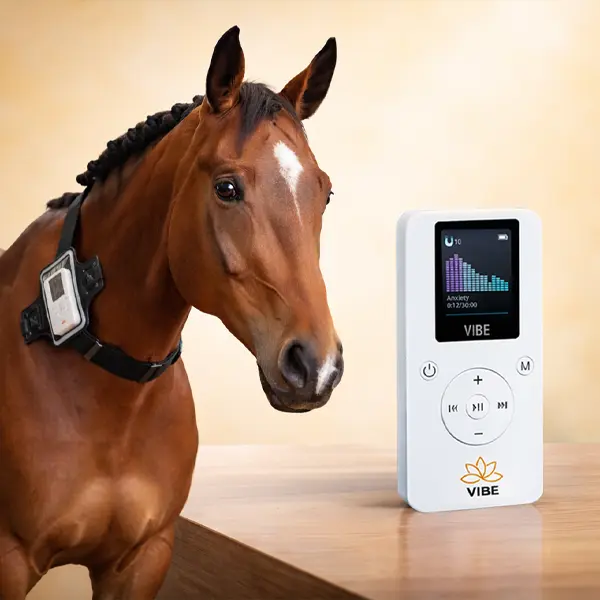
So the order matters. “I tell the owner to call the vet, and then we put that on,” she says: the VIBE, on the setting called Constipation, strapped around the horse’s neck over the vagus nerve. “We still have the vet come out.”
Call the vetAlways first, she says, and the vet still comes out to check and diagnose.
Strap it on the neck“It’s not a big blanket that you have to put on. You strap it around their vagus nerve on their neck.”
Watch“A few minutes, you’ll start to see them calming down. They don’t sweat as much.”
Follow upFor an internal gut issue, she has owners follow up with Brainwave Theta.
She has seen it “about three or four different times now,” she says, and the horses were walking around and drinking water again. “It does not turn them into a diarrhea factory.”
What Christy qualifiedHer timing is an estimate: “almost an instant, I’d say within 15 minutes.” Her count is three or four times. In every case the owner called the vet first, and the vet came out to examine and diagnose the horse. She does not say the VIBE replaces that, and neither do we.
Why the horses walk out to meet her
She used to say a horse can’t feel a placebo.
“I used to say the same thing as everyone else: there’s no placebo effect with animals, and I’ve changed my mind on that.”
Christy Garavetto
Her reason: the animals don’t know what you’re doing to them, but “they know you’re trying to help them.” Her dog, when she had ear mites, would see the Q-tips come out and let it happen anyway. The horses seem to know it too. When she comes to a barn, horses she isn’t working on walk out to see her, and owners ask her, “my horse doesn’t even know you, why are they coming out to see you?”
One mare, a client told her, doesn’t care for the farrier and isn’t overly cuddly. When Christy comes out, she watches what they’re doing, and then she’ll position her body “exactly where … we need to be.” The mare’s name is Christy, too.
Christy, a VIBE in her hands, and a chestnut horse’s nose in her hair.
Then she hands it to the owner
Take it off your horse. Put it on yourself.
That was the ability she wanted. If your horse is now grounded, she says, and you’re going for a training lesson but you’re not, put it on yourself and “go for a ride with it on.”
And her clients had a complaint of their own: sleep. They were waking up in the middle of the night. She told them to try it for 30 days, and if the Sleep protocol hadn’t worked within four days, to switch to Brainwave Delta.
“I have not had anyone come back and say I can’t sleep.”
Christy, on her clients
Sleep is the protocol she uses most herself. If she wakes at one o’clock with a busy mind, she runs Brainwave Delta: “I can turn that on, two minutes, I’m back to sleep.”
And the small ones
The cats decide where it goes.
One of Christy’s clients put the VIBE on for her cats. “The cats are holding it,” Christy says. They lie on it, and then, in her telling, a cat decides: “I’m done with that hip now. I’m gonna lay on the other hip.” So they just choose where it goes.
A cat and a VIBE, from Christy.
A dog and a VIBE, from Christy.
And once, working on a horse, she told the owner to turn it on Vagus Nerve and hand it to her daughter, who was sitting out, mad about something. “Don’t put it on her. Just hand it to her.”
“She never got the machine back. The daughter loved it.”
Christy Garavetto
From Christy’s link
Start where Christy starts.
Christy has owners strap it on the horse’s neck, then take it off and use it themselves. Here are the three ways in.
VIBE
$299
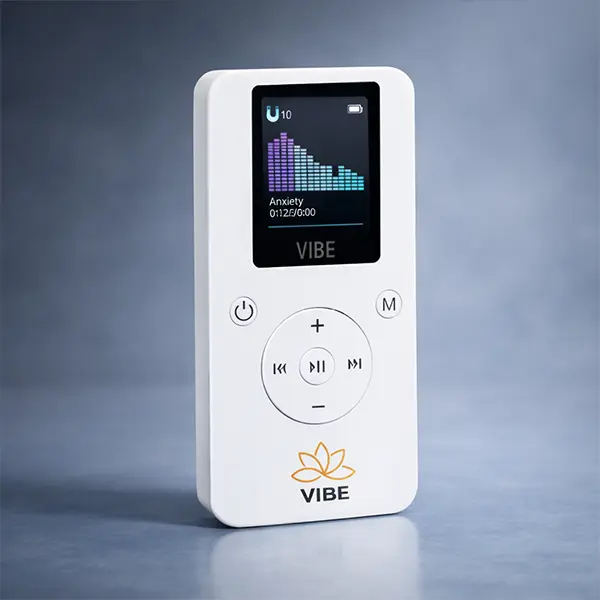
60 core protocols in a device that weighs 2.7 ounces. On a horse, on a dog, or on you.
The VIBE weighs 2.7 ounces – a phone weighs six to eight. On a person, most wear it on the lanyard outside their clothes, or tucked into a pocket. The minimum is one protocol every other day: three or four sessions a week, rotating through the protocols you choose, at any time of day that suits you.
Christy Garavetto, of Interactive Equine Bodywork, is a Resona Health affiliate. This page shares her own experience, in her own words, published with her permission, and she earns a commission on purchases made through it. Individual experiences vary. Nothing here is medical or veterinary advice. Protocol names are device settings, not treatment claims. Talk with your physician, or your veterinarian for an animal, about any health concern, and do not stop or change a prescribed treatment without speaking to whoever prescribed it.
Colic is a veterinary emergency. Call your veterinarian first, every time, as Christy tells her clients to do. In the colic cases she describes, the owner called the vet and the vet came out to examine and diagnose the horse; the VIBE was used alongside that care, never in place of it.
The VIBE is an FDA general wellness device. These statements have not been evaluated by the Food and Drug Administration. This product is not intended to diagnose, treat, cure, or prevent any disease.
Resona Health · info@resona.health · resona.health