
C3I Landing Page V3
Your vet sees your dog for less than 5% of the week.
Even at four appointments a week. Veterinarian Tom Walsh did that math years ago, and it's why he ran a 25-dog study on the other 95%: what happens at home.


From a conversation between Tom Walsh, DVM, of PrimePet Rehab and Mark L Fox, founder of Resona Health
Mon
Tue
Wed
Thu
Fri
Sat
Sun
4 hours at the clinic164 hours at home
The math every rehab vet knows

Even if I saw you four days a week, which would be very difficult for most pet owners to arrange, and incredibly expensive, I'd still only have your dog less than 5% of the week. So what happens at home really makes a difference.Tom Walsh, DVM, PrimePet Rehab
Dr. Walsh's patients are mostly older dogs with arthritis, dogs recovering from surgery, and dogs with anxiety. He can do a lot in an hour. He can't be there at 2 AM when a stiff dog tries to get off the bed, or at 5 PM when the anxious one is alone.
That's what drew him to the VIBE, a small PEMF device that slips into a vest or bandana at your dog's chest.
For owners to be able to say, "Oh, I can just slip this in a bandana or on a harness," it really makes a difference. You're getting the possibility of seven-day-a-week treatment, and that really changes the game in these animals' lives.Tom Walsh, DVM
How the study worked at home
- One visit to the clinicEach dog came into PrimePet Rehab. Dr. Walsh and Mark used an AI tool they built to review each dog's history and pick the protocol to run at home.
- A baseline weekEvery dog wore a MiniTailz biometric collar for about a week before therapy, recording heart rate, sleep, and activity. The owner filled out a 23-question comfort and calmness survey.
- 30 to 60 days of VIBE at homeThe owner ran the VIBE in a vest or bandana over the dog's heart and vagus nerve, on the owner's own schedule.
- The same survey againThen Dr. Walsh asked every owner one open question: how is your dog doing?
What happened in the other 164 hours
Dr. Walsh says there's nothing better than asking an owner how their dog is doing and watching their face light up: "You're not going to believe what he did this week."
On the couch
Dogs that hadn't jumped on the couch in several years jumped up on their own, and were perfectly happy doing it without assistance.In the car
Dogs started getting into the car on their own, without help.With company over
A dog who normally hid in the corner when family visited came out and mingled. Relatives asked the owner, "What drug is he on?"
Home alone
Weston is a Belgian Malinois, a breed with a motor that never stops, and his mom is a travel nurse working long hospital shifts. She saw him calmer and more content for hours afterward.Very often they're feeling better before I'm ready for them to move more. So I have to coach the owners: I know he's jumping up on the bed, but that bone's not ready yet. Let's tap the brakes a little. But that's a great problem to have.Tom Walsh, DVM
What the owners reported
100%At the end of the study, Dr. Walsh asked every owner one question: "How is your dog doing?" All 25 said their dog was doing better.


Some of the dogs in the study.
Your vet handles the 4 hours. The study dogs had help for the other 164: a VIBE in a vest, at home, on their own schedule. Here's how to get the same setup.
What the study dogs used
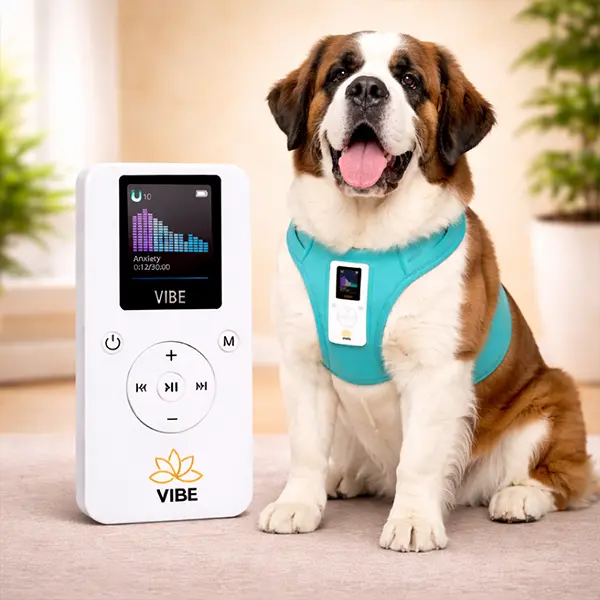
VIBE + Dog Vest Bundle
$328.99$428.99 $100 off
- The VIBE plus a vest that holds it over the heart and vagus nerve, the study placement
- Best for daily sessions, walks, and active dogs
The device by itself

VIBE
$299$399 $100 off
- 60 protocols built in, including Arthritis, Anxiety, Sleep, and Vagus Nerve
- Works for dogs, cats, horses, and people
Already have a VIBE?

Dog Bandana
$29.99
- Zip pocket keeps the VIBE at the chest
- Soft and washable. Great for couch sessions, storms, and travel.
Free shipping and a 30-day money-back guarantee on every order. No subscription.
Read the research
Start with our study, as a short summary or the full report. The four published trials and review below were run by university and hospital researchers using other PEMF devices, and show what the wider research on PEMF in dogs has found.
- Our study: summaryC3I Study Results, PrimePet Rehab, 2026Four pages: how the study worked, the before-and-after scores, owners' own words, and what the collars recorded.Download the summary
- Our study: full reportC3I Study Report, PrimePet Rehab, 2026Tom Walsh, DVM, and Mark L Fox. All 21 pages: methods, statistics, results for every dog, collar data, limitations, and every owner's written response.Download the full report
- OsteoarthritisŠutalo S, et al. BMC Veterinary Research, 2025Randomized, double-blind, placebo-controlled trial in 21 dogs with osteoarthritis. Dogs receiving PEMF showed significantly better gait symmetry after six weeks.Read the full study
- Hip painKühl LF, et al. Veterinary Research Communications, 2025Randomized trial in 20 dogs with hip osteoarthritis. The PEMF group showed significant pain reduction on two validated canine pain scales.Read the study
- After surgeryAlvarez LX, et al. Journal of the American Animal Hospital Association, 2019Double-blind, placebo-controlled trial in 53 dogs after spinal surgery at the Animal Medical Center in New York. PEMF dogs had better wound healing at six weeks and needed pain medication less often in the first week.Read the abstract
- OverviewGaynor JS, et al. Research in Veterinary Science, 2018A review of PEMF in veterinary medicine, covering the evidence for bone healing, wound healing, osteoarthritis, inflammation, and post-operative pain.Read the review