
C3I Landing Page V3
Nobody does surgery with a ball-peen hammer.
So why do most PEMF devices for dogs play one frequency for everything? That question is what turned a skeptical veterinarian into the lead investigator on a 25-dog study of the VIBE.


From a conversation between Tom Walsh, DVM, of PrimePet Rehab and Mark L Fox, founder of Resona Health
"I was even a little bit skeptical"
Dr. Walsh found Resona Health by accident. He was shopping for a PEMF device for his rehab practice because the ones on the market weren't doing enough, or had gone out of production. He'd seen dogs on PEMF mats before, and his honest read was that it mostly looked like relaxation.
They were a little more calm. They were easier to work with. So, okay, it's doing something. But those devices produce a general type of frequency, one signal for every dog and every problem.Tom Walsh, DVM
Then he learned the VIBE doesn't play one signal. It carries 60 built-in protocols, each tuned to a specific condition.
When I realized you could tune it to specific conditions, that's a game changer. This changes everything. You wouldn't use a ball-peen hammer in surgery when you could use a laser to cut tissue. Same kind of thing. It's a quantum leap forward in treating animals.Tom Walsh, DVM
How he explains it to owners

"Remember road trips as a kid? Your dad would tune the AM radio to a station, and you'd sail along for 250 miles listening to it. Tuning these frequencies to specific conditions is that same crystal-clear communication. The body hears it in the cells, and they respond."
"That one-size-fits-all mentality doesn't necessarily work. When you have an arthritic animal and you can dial it in for arthritis, that makes a big difference."Tom Walsh, DVM
Tap a protocol to tune in. Four of the 60 built into every VIBE.
Then they tuned it to each dog
For the study, every dog came into PrimePet Rehab first. Dr. Walsh and Mark used an AI tool the two of them built to look at each dog's history and recommend which protocol to run at home. It doesn't replace the veterinarian. It helps him pick the station.
Each dog wore a MiniTailz biometric collar for a week before therapy started, to record a true baseline. Then the owner ran the VIBE at home, in a vest or bandana at the chest, for about a month.
At the end of the study, Dr. Walsh asked every owner one question: "How is your dog doing?" All 25 said their dog was doing better.
The collars told a story too. Heart rate variability is the body's balance between gas pedal and brake, and athletes chase it hard. When Mark ran his first human heart rate variability study, he told the doctor running it he was disappointed with a 48% result. The doctor's answer: a professional NFL athlete would pay $10 million for a 10% increase.

Maximus
Maximus came to Dr. Walsh with a pinched nerve in his shoulder. His heart rate variability went up during the study, and Dr. Walsh singled him out for a reason.
He was dealing with something that should have pushed those numbers the opposite direction. Seasonal allergies, scratching more, licking at his skin. You'd expect his anxiety, pain, and inflammation to go up and his heart rate variability to go down. To see it improve means that in spite of the circumstances, he was feeling better.Tom Walsh, DVM
PEMF has been used in animal welfare over in the UK for the better part of 30 years. This is not something you invented in your garage. The technology exists. The more we point it in specific directions, the more we can fine-tune it.Tom Walsh, DVM
That's the laser instead of the hammer: 60 tuned protocols in a 2.5-ounce device, riding in a vest over your dog's heart. It's the exact setup the study dogs used. Here's how to get it.
What the study dogs used
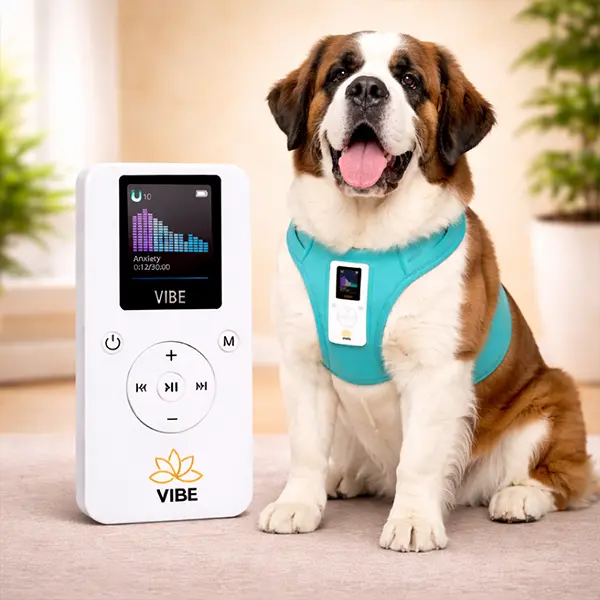
VIBE + Dog Vest Bundle
$328.99$428.99 $100 off
- The VIBE plus a vest that holds it over the heart and vagus nerve, the study placement
- Best for daily sessions, walks, and active dogs
The device by itself

VIBE
$299$399 $100 off
- 60 protocols built in, including Arthritis, Anxiety, Sleep, and Vagus Nerve
- Works for dogs, cats, horses, and people
Already have a VIBE?

Dog Bandana
$29.99
- Zip pocket keeps the VIBE at the chest
- Soft and washable. Great for couch sessions, storms, and travel.
Free shipping and a 30-day money-back guarantee on every order. No subscription.
Read the research
Start with our study, as a short summary or the full report. The four published trials and review below were run by university and hospital researchers using other PEMF devices, and show what the wider research on PEMF in dogs has found.
- Our study: summaryC3I Study Results, PrimePet Rehab, 2026Four pages: how the study worked, the before-and-after scores, owners' own words, and what the collars recorded.Download the summary
- Our study: full reportC3I Study Report, PrimePet Rehab, 2026Tom Walsh, DVM, and Mark L Fox. All 21 pages: methods, statistics, results for every dog, collar data, limitations, and every owner's written response.Download the full report
- OsteoarthritisŠutalo S, et al. BMC Veterinary Research, 2025Randomized, double-blind, placebo-controlled trial in 21 dogs with osteoarthritis. Dogs receiving PEMF showed significantly better gait symmetry after six weeks.Read the full study
- Hip painKühl LF, et al. Veterinary Research Communications, 2025Randomized trial in 20 dogs with hip osteoarthritis. The PEMF group showed significant pain reduction on two validated canine pain scales.Read the study
- After surgeryAlvarez LX, et al. Journal of the American Animal Hospital Association, 2019Double-blind, placebo-controlled trial in 53 dogs after spinal surgery at the Animal Medical Center in New York. PEMF dogs had better wound healing at six weeks and needed pain medication less often in the first week.Read the abstract
- OverviewGaynor JS, et al. Research in Veterinary Science, 2018A review of PEMF in veterinary medicine, covering the evidence for bone healing, wound healing, osteoarthritis, inflammation, and post-operative pain.Read the review