
Brendas Story V1
Brenda Duncan · Zionsville, Indiana
She put it in a drawer.
Twelve days in California, then home to the big mat. What pulled it back out of the drawer kept her and her husband from a single sick day all year.

Brenda Duncan, Zionsville, Indiana
The part she'd rather not admit
Brenda already believed in PEMF. That was the problem.
She'd owned a full-size PEMF mat for five years. She knew what the technology did. But the mat doesn't travel. It's big, it's expensive, and if the airline loses it or crushes it, that's a lot of money in a baggage claim office. So when a pocket-sized version from Resona Health kept showing up in her social media feed, she did the math out loud to her husband: it's a fraction of the price, and there's a money-back guarantee. If it does nothing, it goes back. No loss.
He said sure, try it.
They flew to California for twelve days. She wore it religiously. She did great with it.
Then she came home, put it in a drawer, and went back to her mat.
“For some reason, I don't know why. I did great with the VIBE. But I came back home, I put it in a drawer, and I went back to my mat.”
Brenda DuncanThat's where most stories like this would end. A gadget in a drawer, a guarantee that quietly expired, a mat in the other room.
What pulled it back out
The PTSD interviews.
Brenda started seeing interviews with Mark L Fox, the founder of Resona Health, about the company's PTSD study. The numbers people were reporting stopped her. “I thought, this thing is legit.” And she realized something about the twelve days in California: she'd only been running a couple of settings. She'd never gone through the list. She'd never taken advantage of what was actually in the device.
“It's definitely coming out of the drawer again.”
Cold and flu season was about to start. She and her husband decided to run the Common Cold and Flu protocols, both of them, every day, the way she'd used the VIBE in California. They were around a lot of sick people that winter.
12days in California
0sick days that year
2VIBEs in the house now
Neither one of them got sick the entire year. As of the day we talked, they still hadn't.
The night before our interview she felt a cold coming on, with a procedure scheduled for the next morning that would be cancelled for any symptoms. She ran Common Cold and Immune Support that evening. “This morning I felt fine.”
The number on her finger
Her Oura Ring said her HRV was in the high teens.
Brenda bought the ring about a year and a half ago because she wasn't sleeping and wanted something to tell her when it was time to go to bed. What it told her instead was that her heart rate variability was sitting in the high teens and low twenties.
She remembered she had a Vagus Nerve protocol on the VIBE. So she started running it.
Her HRV has been as high as 39.
Her sleep routine now comes from Doris in the Resona Health Therapy Facebook group, who never says “this will fix that” but will suggest a stack to try. Brenda's is Vagus Nerve, Relax and Balance, Brain Wave Delta, and Sleep, run in the evening. Some nights she runs Vagus Nerve twice.
“When I don't sleep, it's not because I was using it. It's because I wasn't using it at all.”
Brenda DuncanAn Oura Ring can tell you that you slept badly last night. It can't make you sleep better tonight. That's the difference Brenda found once the VIBE came out of the drawer: one device measures, the other one does something about it.
What she runs, and when
The settings that came out of the drawer with it.
Every one of these is a built-in protocol on the VIBE. Brenda picked hers by reading the list she'd skipped in California.
Common Cold & Immune Support
Any time she's in a crowded room. The whole cold and flu season. The night she felt something coming on.
Vagus Nerve
The protocol that moved her HRV from the high teens to as high as 39 on her Oura Ring.
Sleep stack
Vagus Nerve, Relax and Balance, Brain Wave Delta, Sleep. Evenings. Her rule: the nights she skips it are the nights she doesn't sleep.
Brain Wave Alpha & Brain Fog
For the mornings after a bad night, when she wakes up wondering how she'll get through the day.
Fibromyalgia
The setting she put on a friend's bandaged knee. More on that below.
Relax & Balance / Anxiety
Two of what Resona Health calls the Power of Four, with Vagus Nerve and PTSD. If one doesn't sit right, try another.
The skeptic in the house
Her husband puts up with a lot.
Brenda is the one who tries things. He's the one who watches. But he's the one who wanted his own VIBE, and now he wears it every day. He ran it for his back. The thing he mentions most, though, is focus: he's in and out of meetings all day, and he says it's helped him concentrate. One morning on the road, after a bad night, he told her he felt foggy. She had hers in her purse. He put it on Brain Fog. It helped.
Her granddaughter runs Vagus Nerve. Her brother has circulation trouble behind one knee that surgery wasn't going to fix, so Brenda told him about it. He got one. She dropped by one afternoon to ask how it was going and he answered with a question: “Well, where's yours?” His was under his shirt.
“Everybody that has gotten it has just loved this. And everybody has different issues.”
Brenda DuncanFive minutes
The knee that was wrapped in bandages.
A friend of Brenda's had just come through her second knee replacement. The first one had been undone by a bad fall that hyperextended the joint; the surgeons thought she might lose the leg. Nothing was touching the pain.
Brenda is careful about this. Before she brings the VIBE up with anyone, she asks one question: what are your thoughts on non-traditional medicine? Her friend was all for it. So Brenda told her what she and her husband had seen, put the VIBE on Fibromyalgia, and her friend set it on the knee, right over the bandages.
Five minutes in, her friend said her pain had dropped significantly. Five minutes after that: “I feel like my nerves... I can feel the nerve endings trying to find each other.”
Two weeks later, Brenda saw her walking in heels.
She became a Resona Health affiliate on the spot. Brenda has no idea how many people she's told since, and that's the pattern: people get one, get excited, hand it to a friend, and nobody keeps count.
Her friend Sandy in Florida is the same way. Arthritis, bone-on-bone pain, kidney trouble; she wears hers daily. She helped one person who then ordered ten VIBEs for a group out west. And when a dentist wouldn't start a procedure because Sandy's blood pressure was too high, she asked to use her VIBE first. They left the room. Five minutes later they came back, took it again, and went ahead.
The airport question
“Did you have any trouble at TSA?”
Everyone asks. Brenda walked through security at O'Hare wearing hers. Nobody said a word.
Mark L Fox has been trying for years to get stopped, so he'd know what to tell people. He can't. He once dumped fifteen of them in a single bin. The TSA agent looked at the pile and said, “You can't have that many TV remotes in one bin. Put them in three bins.” That was the whole inspection.
If anyone does ask, the honest answer is that it's an MP3 player. Every protocol is literally an audio file, and the circuit board is an MP3 player's. It just has a coil where the speaker would be.
Brenda's advice
Don't do what she did the first time.
Read the whole list. Pick the protocols that fit you. Then keep going. The minimum that works is one protocol every other day, three or four sessions a week, rotating through the ones you chose. You can run them more often, and at any time of day. What doesn't work is twelve good days and a drawer.
Wear it on the lanyard around your neck, drop it in a pocket, or tuck it in a bra. It's 2.4 ounces. You'll forget it's there, which is the point: her brother wears his under his shirt all day, her husband wears his through back-to-back meetings, and Brenda has hers in her purse on the days she isn't wearing it.
And if you get it wet, skip the bag of rice. A blow-dryer is what actually works.
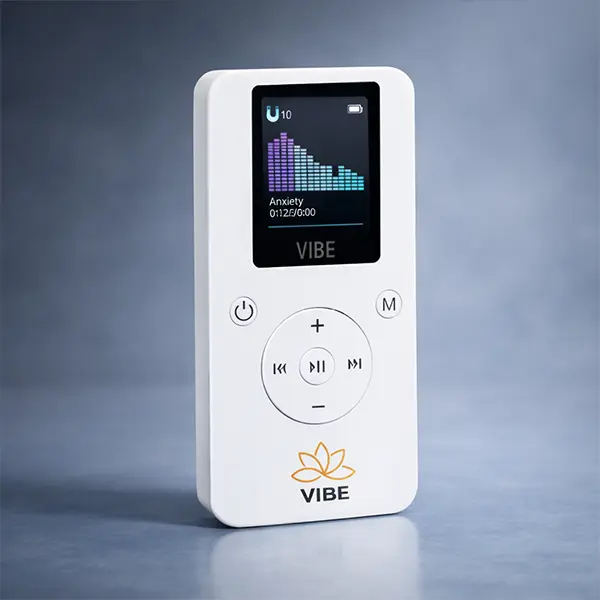
The VIBE, from Resona Health
$299 $399
A pocket-sized PEMF device with 60 core protocols and 70 expansion protocols built in, including every one Brenda runs. One button. No app, no subscription, nothing to figure out. It goes through TSA without a second look.
- 2.4 ounces; wears on the included lanyard, in a pocket, or tucked away, and works through clothing
- Rechargeable, about 5 hours per charge at full power
- Safe for people and pets
- Free shipping worldwide
- 30-day money-back guarantee and 1-year warranty
The guarantee is the reason Brenda's husband said yes. Thirty days. If it does nothing for you, send it back for a full refund.
The mat is still in the other room.
Brenda hasn't gotten rid of it. She just doesn't reach for it. The thing she reaches for is around her neck, or in her purse, or on her husband, or under her brother's shirt, or on a friend's bandaged knee.
It spent months in a drawer because she thought she already knew what it could do. She didn't. Neither do you, yet.
Thirty days. Read the whole list this time.
See more Resona Health products
The VIBE isn't the only thing in Brenda's house.
She owns a BlueVibe too. And the ring on her finger is the reason she knows her Vagus Nerve numbers at all. Three more from Resona Health, every link carrying Brenda's name.

BlueVibe
$349 $499
PEMF and blue light, both pulsed at 40 Hz, in a one-button wearable for the wrist or the back of the neck. Made for focus, memory, and mental clarity. The one Brenda's husband would reach for on a foggy morning.
See the BlueVibe
VaguVibe
$249 $349
A pendant worn over the chest that gently supports the vagus nerve with low-level PEMF all day. No menus, no sessions, nothing to feel. The all-day version of the protocol that moved Brenda's HRV.
See the VaguVibe
Kario Wellness Watch
$149
HRV, sleep, heart rate, blood pressure, blood oxygen, and a single Vitality Score, on your wrist. The two numbers that matter most are sleep and HRV. Brenda watches hers on a ring; this is the same measurement for a fraction of the price.
See the Kario WatchThe VIBE, BlueVibe, and VaguVibe are FDA general wellness devices. These statements have not been evaluated by the Food and Drug Administration. This product is not intended to diagnose, treat, cure, or prevent any disease. Individual results vary.
Nothing on this page is medical advice. The stories here are Brenda Duncan's own and those of family and friends she knows. Protocol names are the names of settings on the device, not claims of treatment for any condition. Heart rate variability figures are her own consumer wearable readings. See your physician for any health concern.
Brenda Duncan is an independent affiliate of Resona Health and earns a commission on purchases made through the links on this page, at no additional cost to you.