Bob’s Story V3
Nothing in this story happened gradually.
A physicist left cancer medicine on a single question. His life came apart all at once. A forty-six-year phobia ended in one hour. Every turn happened at a threshold, the way ice becomes water — and he thinks your body works the same way.
Two facts.
Water at 99 degrees is still water. At 100, it's something else.
Your brain has states too. It thinks in one and heals in the others.
So if the body only does its repair work in a state you have to cross into — what matters isn't how hard you try to relax?
Right. It's whether you cross.
That idea belongs to Bob Ross: nuclear physicist, medical physicist, fire department medic, and the oldest son of an undertaker. His whole life is a series of thresholds. Here they are, in order.

Bob Ross
Undertaker → medicineThe family business was the cold room.
His father was a mortician. So was his grandfather. Bob was the oldest boy and the plan was settled before he could object: he'd be an undertaker.
He went into medicine instead, "to save people from having to see my dad." His father, in time, put an arm around him: "Son, your mother and I are so proud of you and all the life-saving awards you've won. But Son, you're bad for business." Bob still calls it the best compliment he ever got.
The other side of the family gave him the thing that made the rest of this possible. His mother was a professional musician. Her father was a famous research chemist, and there are around 150 patents in that line. Ideas for inventions arrive in Bob's head uninvited. They always have.
Physics degree, nuclear focus. Then a prestigious medical school and a PhD track in medical physics — the physics of treating cancer. Eleven years of school.
Fury → discovery
He was forced onto the team that changed his life.
Bob didn't choose the research group. He was assigned to it, had to pay for it as a class, and was furious. "I was so mad," he says, "and yet what a beautiful thing that was."
Someone on that team had a thought nobody had tested: are cancer cells affected by heat? They were. Raise their temperature and they get weak. It came to be called the hyperthermia effect, and the implication was that if you warm the body first, you can use less chemotherapy and less radiation to get the same result — with fewer side effects. The team was ecstatic.
Bob says it went on to be used in clinics in Europe, East Asia, and Mexico. In the United States it stalled, and the explanation he kept hearing was that less chemo and less radiation meant less profit. A physician friend said it flatly: "Bob, it's the business of medicine. It's not healthcare."
Notice the shape of that. A catastrophe — being forced onto someone else's research, which slowed down his own research — turned into the thing that gave him standing in the cancer field. That shape is going to repeat.
Cancer medicine → the ambulance
One question, and he was on the other side of it.
He remembers putting it to his professors. Exposure to radiation can cause cancer — that's why we wear the detectors. Exposure to chemotherapy drugs can cause cancer — that's why we gown up. So how can two things that cause cancer cure cancer?
"Well, it doesn't," he was told. "We're just trying to kill cancer cells."
And the immune system that has to clear those dead cells? Suppressed by the same treatments.
He finished his internship at a hospital in Oregon and walked away from traditional cancer therapy. He went into emergency medicine and joined a fire department's EMS reserve — the one corner of the field he'll praise without qualification. "In emergency medicine we're the best in the world. Absolutely the best in the world."
He also started paying attention to something he'd been ignoring. On Rose Bowl duty he'd be posted to one tunnel and get a clear thought: go to a different one. Another team's district. Made no sense. He'd go anyway, and within about thirty seconds someone there would need him. "I've brought two people back from the dead because of that." He calls them intuitive hits. Everyone gets them; most people talk themselves out of them.
Success → collapse → the sealed room
Then everything went at once.
Things were going well. Then they weren't, and it wasn't gradual. Friends kept asking why he'd sabotaged it. He hadn't, he said. They were sure he had.
A psychologist told him, a few sessions in: you have a fear of success. Bob's reply was roughly get out of here — he'd been working his tail off to succeed. But the pattern was real. And when he asked what to do about it, the psychologist said that wasn't for him to say. It was an individual thing.
So Bob went looking himself. He learned the subconscious mind's job is to keep you safe. And he learned, not long after, that something from his childhood had been severe enough that his brain had sealed it off entirely. Encapsulated it. His conscious mind had no memory. His subconscious did — and it had decided that it was not safe to be seen. Success meant being seen. So success got quietly dismantled every time it approached.
There was one more threshold in the same stretch. During medical school he was diagnosed with a brain tumor. He's doing well now. He'll also tell you he was tense and freaked out with the diagnosis — and that was a problem in and of itself: tough to heal.
"Again, it was a beautiful gift." Bob Ross, on being told the psychologist couldn't help him
Beta → alpha → theta
A brain has states, like water does.
Talk therapy hadn't reached the sealed room. So the inventor in him asked a physicist's question: what state does the brain have to be in to reach it?
Beta
Awake, alert, thinking. Where you are now.
Most of the dayAlpha
Slower. Meditation, beautiful music. Bob's position: the body does its real healing from here down — and the more frightened you are, the harder it is to reach.
Reachable with practiceTheta
Just before sleep. A floating feeling, a color, and then you're out. The subconscious is reachable here.
About five seconds, for most peopleThat five-second window is the whole problem. Theta is the state where a belief like it isn't safe to be seen can be found and rewritten, and most people pass through it once a night on their way to unconsciousness. So Bob invented a way to hold the threshold open — to get into theta without falling asleep.
He paired it with EFT, the tapping technique he studied with its originator, Gary Craig. His explanation for why it works is pure physiology and physics: emotional traumas that cause PTSD and phobias result in an electrical disturbance in the nervous system, tapping the points where nerves surface sends a signal down the line, and it defibrillates the disturbance the way you'd defibrillate a heart. An electrical problem, an electrical fix.
And somewhere in here he found an answer to a question he'd had since he was a kid in a loving Christian home: why would God ask for faith before healing? The placebo studies gave it to him. The people who get better on a sugar pill are the ones who believed it was real. Which means the healing was already in them. "It's like water in a pipe," he says, "and faith is what turns the spigot on and lets it flow." He rebuilt his technique to throw that switch on purpose.
Response → healing
The body changes phase too. On its own.
Twist your ankle and the body responds with inflammation. Uncomfortable, and purposeful — more blood, more oxygen, faster repair. Then, when the ankle is healed and the inflammation isn't needed, the body takes it away. Nobody instructs it. It just crosses from response into healing.
Trauma. Response. Healing. Bob says it's always those three, and the response is always on your side even when it hurts. Which makes most of what we did to ankles for decades — wrap, ice, ibuprofen — an attempt to stop the body mid-phase. Even the man who coined "RICE" has since said not to.
Bob had a thought at eight or ten years old, watching his grandmother go through cancer: I wonder if an emotional trauma caused this. It came back to him about a year and a half ago, and he went digging. He remembered that something like 80 to 85 percent of the cancer patients he'd treated had unresolved emotional trauma. He found a physician in Europe who'd documented the same thing across tens of thousands of patients and described the disease as a biological response — one that stops, and reverses, when the trauma beneath it resolves. That physician also found something Bob can't fully explain: the healing took as long as the trauma had taken to resolve. Eight months of trauma, eight months of healing. Four and four. One to one.
So the inventor went back to work. His technique now does two things: separate the emotional trauma from the response the body mounted to it, and then instruct the subconscious to move through the healing phase "as fast as is safe as possible." He's watching the results. He uses the word amazing and doesn't apologize for it.
- A dog phobia, ten out of ten, no known cause→gone in about an hour. Three years on, he owns a dog.
- A 56-year-old phobia, daily, unmoved by years of therapy→gone in one session. It didn't come back.
- A memory sealed for decades→surfaced eight minutes into a slowed-down session.
The dog phobia is the one he tells most. Eight minutes in, in a slowed brain state, the memory popped: eight years old, on a bike, a dog foaming at the mouth and chasing him. Of course a child would carry that. Afterward his sister's big dog ran straight at him and he was calm. She took him to the dog park to make sure.
None of that was gradual either.
War → love
The last threshold is a word.
Cancer cells are your own cells. They started duplicating too fast, got greedy for glucose, stopped cooperating. A real problem — and still yours. Now think about what "war on cancer" does to a body. Nobody goes into battle relaxed. The word alone pushes you up into beta and holds you there, which is the one state healing doesn't happen in.
Bob's alternative is to love them — not because they're harmless, but because gratitude is a state change in the right direction. His words: "I'm so thankful and grateful that my body has the ability to heal. I'm so thankful and grateful that it knows what to do." Thank the response for trying to keep you safe. Tell it it can stand down.
He also says, every time, to work with a functional medicine physician or naturopath — someone whose practice is built around helping the body do its own work. This changes the state you bring to care. It doesn't replace it.
Trying → crossing
Crossing on purpose.
Which leaves one practical problem. Everything above depends on getting into alpha or theta — on a Tuesday night, frightened, with a mind running at full speed. Bob spent years building his own way across.
Then he read the VIBE's protocol list and found two presets sitting there: Alpha and Theta. Push a button. "That's why I'm so excited about this thing," he says. "It's unbelievable." He now runs it during his own sessions to help slow a client's brainwave while they tap.
- AlphaThe threshold healing starts below.
- ThetaThe door he spent years learning to hold open.
- AnxietyFor the wild days.
- Brain Balancing"Oh, I could use some of that."
- DepressionHe's crossed back out of it twice.
- Immune SupportThe repair crew.
- Love — 528 Hz"The most powerful frequency on the planet."
- SleepSee below.
Bob's four steps across the threshold into sleep
You can't fall asleep because the brain is running too fast. This slows it. Usually three to five minutes, Bob says — and "if you use the VIBE in addition to that, very powerful."
- Flat on your back. It matters.
- Two or three deep breaths, in through the nose and out through the mouth.
- Roll your eyes up, as if looking through the top of your head. It looks like a zombie. It's a physical trigger that slows the brainwave.
- Now, after every breath in through the nose, as you start to exhale through the mouth, say relaxing — and at the very end of the breath say now! Like a command.
Set the VIBE to Sleep or Theta, rest it on your chest, and start at one.
One warning. Phase changes are easy to forget. Bob watched a woman heal a 56-year phobia in one hour and, a month later, say the method "doesn't work" — because the daily panic was simply gone and her mind had moved on to the next thing. So measure something. Track your sleep. Rate your days. Ask the people who live with you whether you're different. They'll notice the crossing before you do.
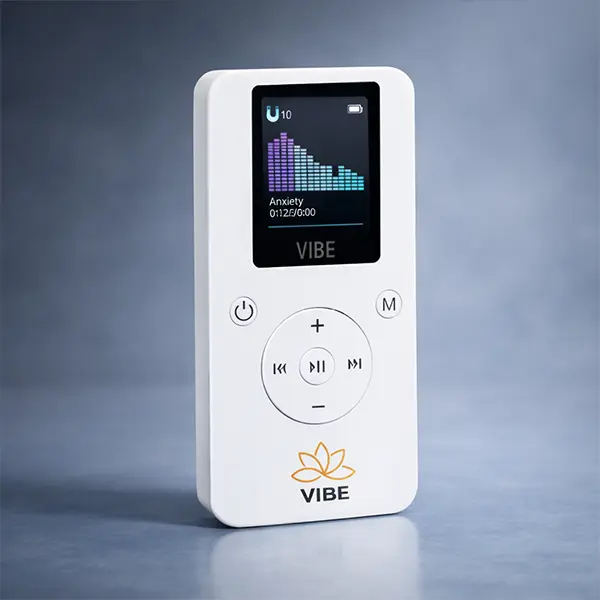
The VIBE, from Resona Health
$299 $399
A pocket-sized PEMF device with 60 core and 70 expansion protocols built in — Alpha, Theta, Sleep, Anxiety, Brain Balancing, Immune Support, and the 528 Hz Love frequency among them. One button. No app, no subscription.
- Pocket or lanyard — works through clothing
- Rechargeable; about 5 hours per charge at full power
- Safe for people and pets
- Free shipping worldwide
- 30-day money-back guarantee, 1-year warranty
Thirty days. If nothing changes, send it back for a full refund.
Bob's coaching program, a free 45-minute masterclass on the three things cancer cells need to survive, and his follow-along EFT tapping training are at thehiddensecrettohealing.com.
Visit Bob's siteBob's father, who spent his life in the cold room, had a line for hard things: "They'll either make you bitter or better, and the choice is yours."
A forced assignment. A question with no answer. A collapse. A diagnosis. A memory sealed for decades. Every one of them was a threshold, and Bob crossed every one in the same direction. He calls each one a gift, and he means it literally.
You don't relax your way across. You cross.
The VIBE is an FDA general wellness device. These statements have not been evaluated by the Food and Drug Administration. This product is not intended to diagnose, treat, cure, or prevent any disease. Individual results vary.
Nothing on this page is medical advice. The views, experiences, and techniques described are Bob Ross's own and are shared as his personal story. Cancer, phobias, and other serious conditions require care from a qualified physician or mental health professional; do not stop, start, or change any treatment without talking to your doctor. For pets, consult your veterinarian.
Affiliate disclosure: Bob Ross is a Resona Health affiliate and earns a commission on purchases made through the links on this page, at no additional cost to you.