
Dr Toms Story V2
Prime Pet Rehab / Myrtle Beach, South Carolina
Not one of his patients has ever told him a thing.
Dr. Tom Walsh sees about thirty dogs a day. Not one of them can say where it hurts, or whether it hurts less than last week. Everything he knows, he has to get some other way.
So he learned to read the go-betweens. A yawn. A lip lick. How much weight lands on one leg.
Why it's harder than it sounds
A dog will hide it from you, and then he'll settle for less.
Dogs are a prey species. Tom comes back to that more than once, because it explains most of what makes his job difficult. An animal built to avoid looking weak learns to adapt fast, and adapting looks a lot like getting better.
His rule of thumb: get a dog to roughly 65 to 75% of normal function in a limb and that is good enough for him. He'll use it like a cane and get along just fine. And then he stops improving, because from his point of view there's nothing left to fix.
So the owner sees a dog walking. The dog has quietly decided that three good legs is the new normal. Someone has to notice the difference.

Dr. Tom Walsh / Prime Pet Rehab, Myrtle Beach
Tom came to this late. He spent his first career in business with a major telecommunications company, retired early, decided he wanted to be a veterinarian, and went to vet school at 40. He practiced several years. Then COVID came, and he wanted to get closer to the animals — more of a connection — and rehabilitation was the thing he'd always been passionate about and never had time to do.
He built Prime Pet Rehab out of his car, driving vet office to vet office. Two and a half years later it had its own building. In 2022 they saw eight to ten dogs a week. Now it's thirty a day.
What he actually reads
Three go-betweens, and what each one tells him.
01
The weight on the leg
Rex came in after a hip replacement, with significant muscle loss in that hind limb. Surgery done, rest at home done, all the things you're supposed to do. Tom estimated he was still placing about 25% of the weight he should have been on it.
Twice a week for three weeks. Seeing him the day before this interview, Tom put him somewhere in the neighbourhood of 75%. He's strong enough for hydrotherapy now, which he wasn't before — and what's left is habit, because dogs get into one the same way we do and have to be retrained out of it.
02
The lip lick, the yawn, the curl
A dog arrives so anxious you can't put a hand on him. There is no scale for that and no way to ask. What Tom watches for are the involuntary tells — a dog licking his lips, yawning, lying down, curling into a ball. Relaxation movements. The animal reporting without meaning to.
03
The owner at home
Gelato had degenerative myelopathy. His mom kept a VIBE at home to supplement, for the difficult days when the nerve connections just weren't firing. She's the one who saw his energy come up. She saw the coordination trying to come back a little.
Tom can only read the dog for the half hour he's in the room. The other hundred and sixty-seven hours belong to somebody else.

Rex at Prime Pet Rehab
Both of Rex's percentages are Dr. Walsh's own visual estimates of weight-bearing, not instrument readings. His words: “I would estimate.”
The reading that changed how he works
One of these two results, he refuses to count.
Tom has held a VIBE an inch or two above an anxious dog's back and waited. Maybe twenty minutes before the dog starts to come down.
And he is the first person to tell you what's wrong with that. It could just as easily be a bored dog relaxing after thirty minutes of nothing happening. He can't tell the two apart, so he won't claim it.
Held over the back
~20 min
Or a bored dog. Tom's own caveat, not ours.
Harnessed over the heart
2–5 min
Lies down. Licks his lips. Yawns. Curls up in a ball.
The second placement only exists because Resona Health's founder built a harness to hold the VIBE on the chest. Gravity takes it off otherwise — there was no other way to keep it there. Under that spot sits the vagal nerve center, which Tom describes as the second-largest nerve center in the body behind the brain stem.
“It is so dramatic, the difference.”
Dr. Tom Walsh
And the harness solved a second problem.
Strapped on rather than held, the device stays put through movement. Tom doesn't stop therapy to run PEMF — the vest goes on and the dog wears it the whole thirty minutes while everything else happens. He calls that a key advantage no other product has. The animal leaves having gotten the maximum amount of therapy possible out of the appointment.
Why this device and not the last one
If you can't ask the patient, you'd better be able to aim.
Tom learned PEMF on other devices. One of them was rechargeable and started having trouble holding a charge; the company he'd bought it from was in a corporate restructuring and the device was no longer being manufactured. So he went looking, and found Resona Health.
What got his attention was that this one is programmable — you select different protocols on it. He'd always thought that beat a one-size-fits-all situation, which is what he says most PEMF devices on the market are: overall general inflammation, some anti-inflammatory, a little pain modulation, aimed broadly at everything.
“And for these animals, I wanted to be able to dial it in.”
Dr. Tom Walsh
Post-surgical, he wanted wound healing. Arthritic, an arthritis setting. Anxious, something aimed at the anxiety. When you can't ask the patient what's wrong, guessing broadly is expensive.

Gelato at Prime Pet Rehab / June 2023
Gelato's course ran three and a half years. Tom's account of the prognosis: neurologists will tell you twelve to eighteen months is a long life cycle once a dog is diagnosed with degenerative myelopathy. Prime Pet Rehab worked on him for three and a half. They lost him recently to a cancer tumor.
Tom does not say the device is the reason Gelato had those years. He says PEMF was a dramatic part of the work they did. We’re not going to draw a line he didn’t draw.
What he does with all of it
Every patient. Every time.
“I’ve made it to where every single patient gets PMF every single time they come here. It’s that important.”
Dr. Tom Walsh
He also believes — and he's careful to frame it as belief, in an area he says the research hasn't caught up to — that PEMF works in tremendous synergy combined with other modalities. Therapeutic laser. Ice and cryotherapy. Electrical stimulation. Stacked together, he says he sees much better results.
He talks to colleagues about it constantly. Their stories are remarkable, he says. But they aren't getting the same rapid pace of turnaround that he is.
The owners, meanwhile, are the one intermediary who can actually speak. Two years running, Prime Pet Rehab has taken a Best of South Carolina regional win for veterinarians, going up against full-service practices while offering none of those services. In the past six months the schedule has gone from three-quarters full to booked a month out with a waiting list. And several owners have bought VIBEs of their own — for their animals, and for themselves.
The device, and where it sits
The same VIBE he puts on every patient.
A programmable PEMF device about the size of a deck of cards — 120 × 59 × 12 mm, 75 grams. It runs 60 core plus 70 expansion protocols, so you select the one you need instead of running one broad setting at everything. PEMF works by resonance rather than intensity: it isn’t a machine that makes muscles contract, and it isn’t meant to be felt.
What changes between these three is only where the device sits on your dog. Tom’s whole account is about that placement, so start with the one that matches it.
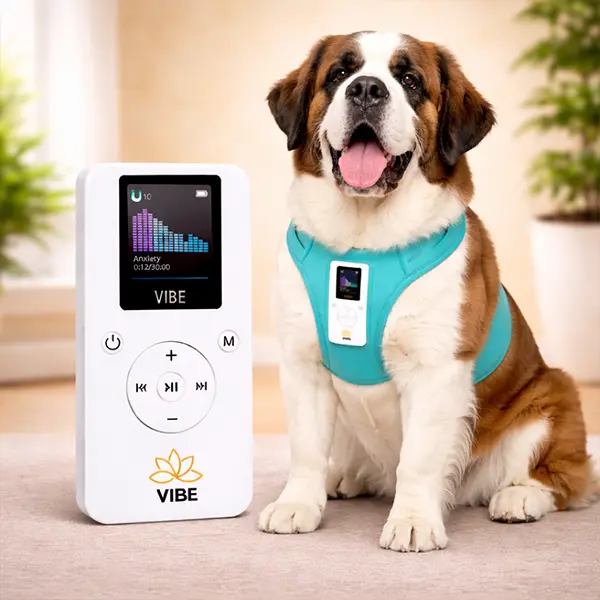
Dog VIBE Vest Bundle
$328.99
The vest holds the VIBE on the chest, directly over the heart and vagus nerve cluster — the placement Tom spends most of the interview on, and the one that stays put while the dog moves.
- Resona VIBE device, 60 core + 70 expansion protocols
- Dog VIBE Vest — sizes S, M, L, XL, adjustable straps
- USB-C cord, lanyard, AC adapter, magnetic field tester, quick-start guide
- When between sizes, size up
Free shipping · 30-day money-back guarantee · 1-year warranty
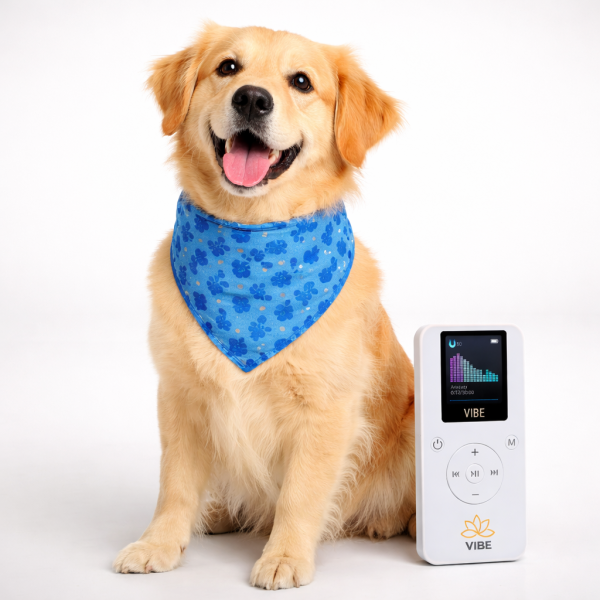 At the neck
VIBE Dog Bandana Bundle
$328.99
Same device, same price. The VIBE goes in a zip pocket on a bandana and sits at the neck, near the heart and vagus nerve cluster. The pick for a dog who won’t tolerate a vest.
- Resona VIBE device, 60 core + 70 expansion protocols
- Custom dog bandana — sizes S, M, L, XL
- USB-C cord, lanyard, magnetic field tester, quick-start guide
- Not sized for extra-small dogs — see below
Free shipping · 30-day money-back guarantee · 1-year warranty

VIBE
$299.00 $399.00
The device on its own, with nothing to hold it. For cats, for extra-small dogs who lie down next to it in their bed, for a second unit — or for you. Several of Tom’s clients bought one for the dog and then bought one for themselves.
- Resona VIBE device, 60 core + 70 expansion protocols
- No app, no Bluetooth, no subscription
- Works on people and animals both
Free shipping · 30-day money-back guarantee · 1-year warranty
Best used three to four times a week. Sessions average about 40 minutes.
Protocols are informed by 600+ published PEMF studies, verifiable on PubMed.
Important: The VIBE is an FDA general wellness device. Statements on this page have not been evaluated by the Food and Drug Administration. This product is not intended to diagnose, treat, cure, or prevent any disease in people or in animals.
The account above is Dr. Tom Walsh’s personal and professional experience, described in his own words in a recorded interview. Individual experiences vary and results are not guaranteed. Percentages and timeframes attributed to him are his own clinical estimates.
Nothing on this page is medical or veterinary advice. The VIBE is not a substitute for veterinary care, diagnosis, or treatment. If something is wrong with your animal, call your veterinarian.
Do not discontinue or change anything a physician or a veterinarian has prescribed without speaking to them first.
Dr. Tom Walsh is a Resona Health affiliate and may earn a commission on purchases made through the links on this page.
© Resona Health. All rights reserved.