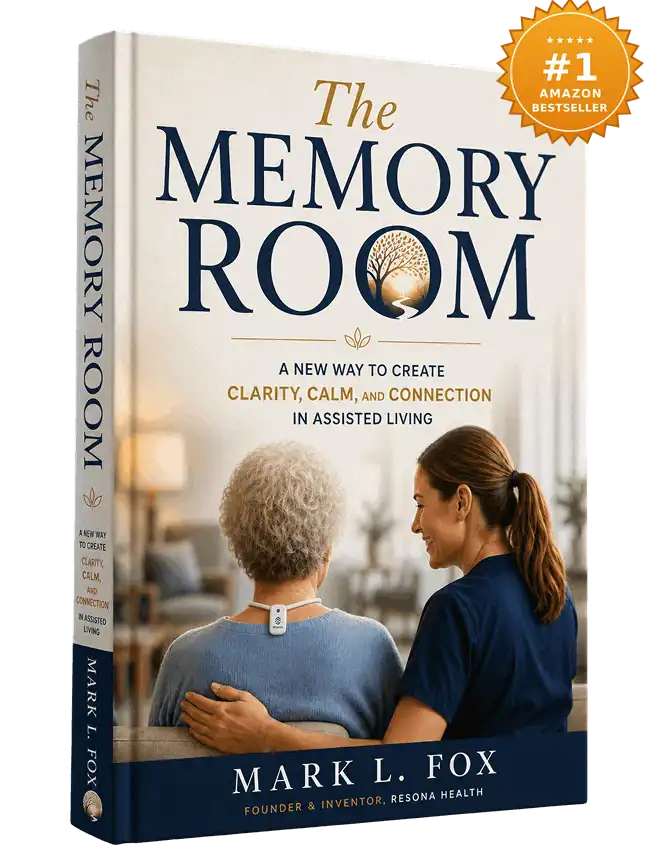
#1 Amazon Bestsellerin Brain Diseases & Nursing Home Care
The good days aren't random.
If you love someone who is slowly slipping away, you already know the rare Tuesday when they come back to you. The Memory Room is about those moments — why they happen, and how families and caregivers can help create more of them.
You already know what this book is about
Most families carry two things at once: love for the person who is still here, and grief for the person who is slowly fading. You see them every visit. The good days, when they recognize you, finish a thought, laugh at the old joke. And the harder days, when the distance feels wider.
Memory-care staff can tell a certain kind of phone call by the tone alone — not a fall, not a complaint. A family member calling because something good happened, and they aren’t quite sure why.
Those good days aren’t luck. They happen when the brain returns, for a while, to its best state of coordination — and a growing body of research suggests they can happen more often than we once believed. This book is written for the people who notice them first: the caregivers who show up every morning, and the families who stay a little longer than they planned.
If you’re caring for someone you love, this is a hopeful, honest place to begin.
Access Your Free Flipbook or PDF Below
What's inside
A clear, hopeful guide —
written in plain language
No jargon. No false promises. Just an honest look at what’s possible, grounded in real science and real experience.
1
The Good Days
Why families call on the quiet Tuesdays — and what those moments are really telling us.
2
The MIT Discovery
What happened when scientists at MIT flickered a light at 40 times per second.
3
What It Feels Like Inside
Listening more carefully to what someone with memory loss is actually telling us.
4
The Study
What 41 people and a six-week trial can — and honestly cannot — tell us yet.
5
The Simplicity Principle
Why the most sustainable kind of support is also the easiest to fit into daily life.
6
When Things Improve
The ripple effects of a good day — for the resident, the family, and the caregiver.
Written by Mark L. Fox
Founder & Inventor, Resona Health
Mark L. Fox has spent years working at the intersection of neuroscience, engineering, and everyday care. In The Memory Room, he draws on MIT’s landmark 40 Hz research and a completed Phase 1 study to make a careful, hopeful case for what families and caregivers can do today. The book is published by Remarkable Press and available on Amazon — and free to read here.
What the early research found
A completed Phase 1 study
Small and preliminary — but the consistency surprised even us.
41
participants, six weeks
Every one
showed measurable improvement
0
regressions or adverse effects
Highly
statistically significant
This was a small, preliminary, self-reported study. It is shared to show why the early signal is worth understanding — not as proof that any device treats, cures, or prevents a medical condition. The book explains, honestly, what these numbers can and cannot tell us.
Start with the book
Get your free copy above of The Memory Room...or if your ready to see results now
Important: The Memory Room is an educational book. Resona Health products, including BlueVibe, are wellness devices. They are not intended to diagnose, treat, cure, or prevent any disease, including Alzheimer’s disease, dementia, or depression. Statements on this page have not been evaluated by the Food and Drug Administration. The Phase 1 study referenced was a small, preliminary, self-reported study; individual results vary and are not guaranteed.